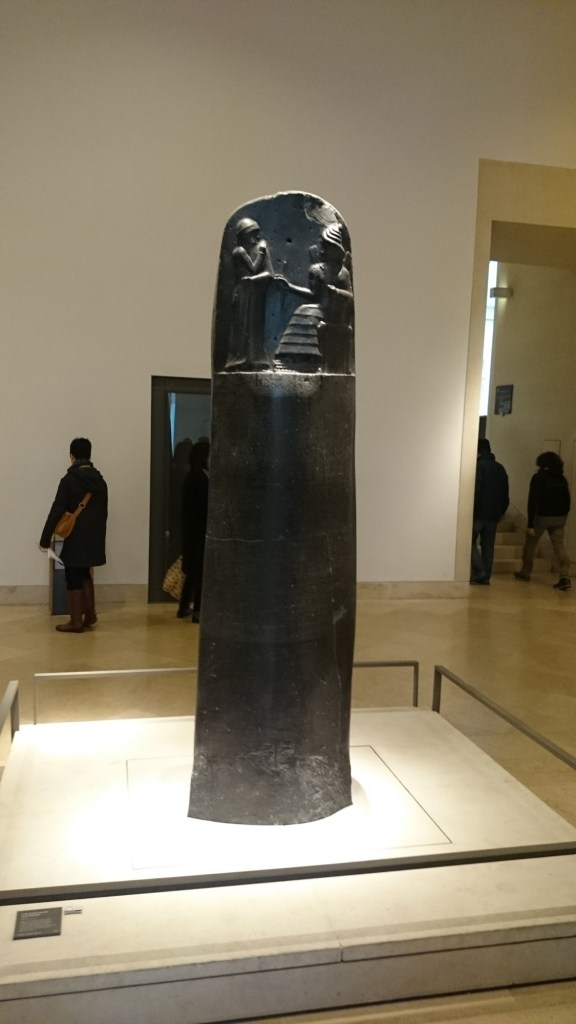
The Code of Hammurabi stele on display at the Louvre Museum. Photo by Gil Dbd, CC BY-SA 4.0, via Wikimedia Commons.
Nearly 4,000 years ago, in ancient Babylon, a king ordered laws to be carved into stone.
Not hidden in a palace.
Not whispered only among priests.
Not passed down only through memory.
Carved.
Written.
Visible.
The king was Hammurabi, ruler of Babylon, and the monument that preserves his legal judgements is now known as the Code of Hammurabi.
It is one of the most famous legal texts in history.
But it is more than a list of ancient punishments.
But they were written down.
It is a window into a world trying to answer one of humanity’s oldest questions:
What does justice look like when people disagree, harm one another, break promises, or abuse power?
The answers Hammurabi’s world gave were not always gentle.
They were not always equal.
They were not modern.
And that changed something.
A king, a city, and a stone
Hammurabi ruled Babylon in the 18th century BCE, during a time when Mesopotamia was filled with cities, kingdoms, temples, farmers, merchants, soldiers, slaves, families, debts, contracts, disputes, and power struggles.
In other words, a complicated society.
Complicated societies need rules.
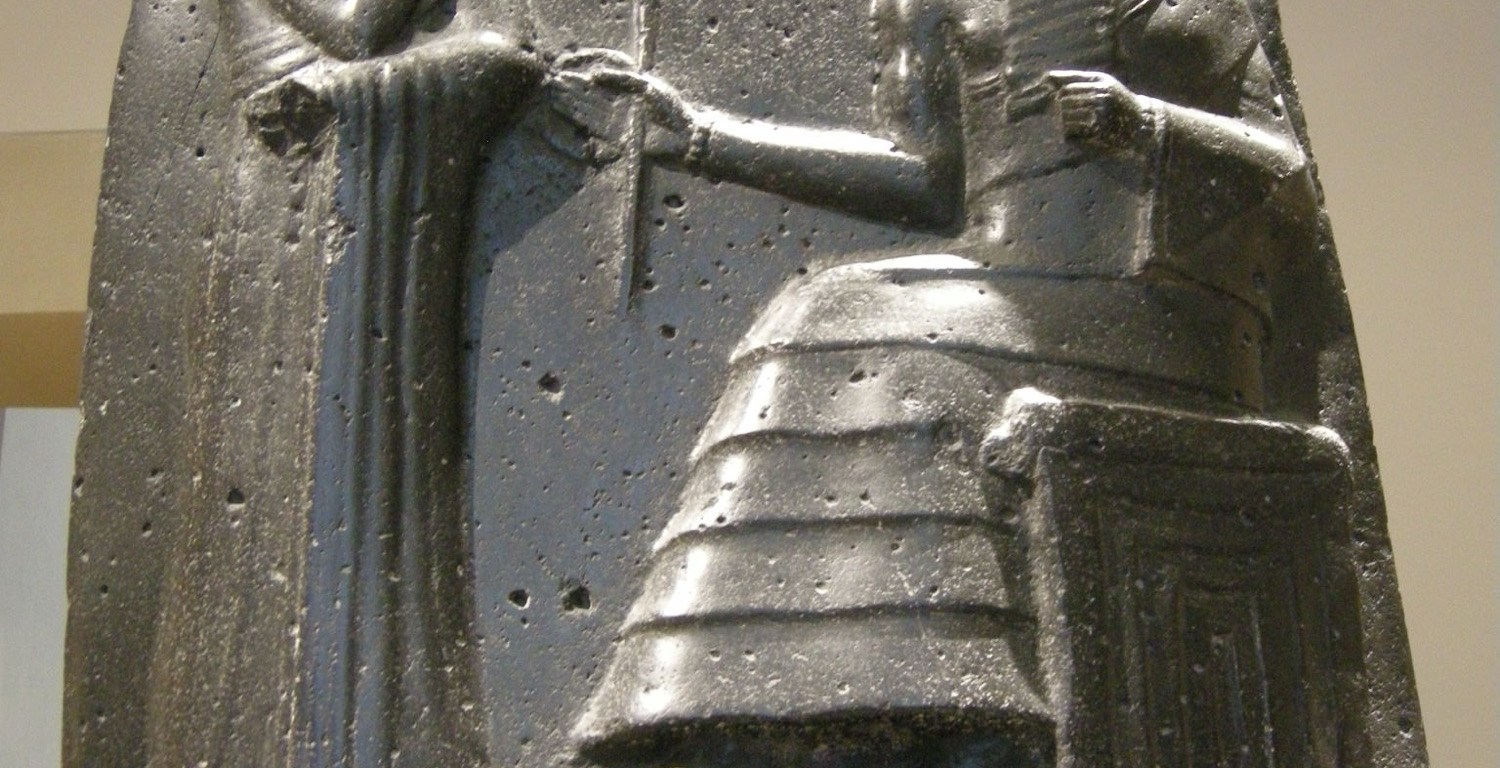
The Louvre describes the Code of Hammurabi stele as a black basalt monument over 2.25 metres tall, engraved around 1750 BCE, and now one of the most iconic monuments of the ancient Near East.
At the top of the stele is an image of Hammurabi standing before Shamash, the Mesopotamian sun god associated with justice. Below that image are rows and rows of cuneiform writing.
The message is clear.
Law was not being presented as random royal opinion.
It was being framed as justice under divine authority.
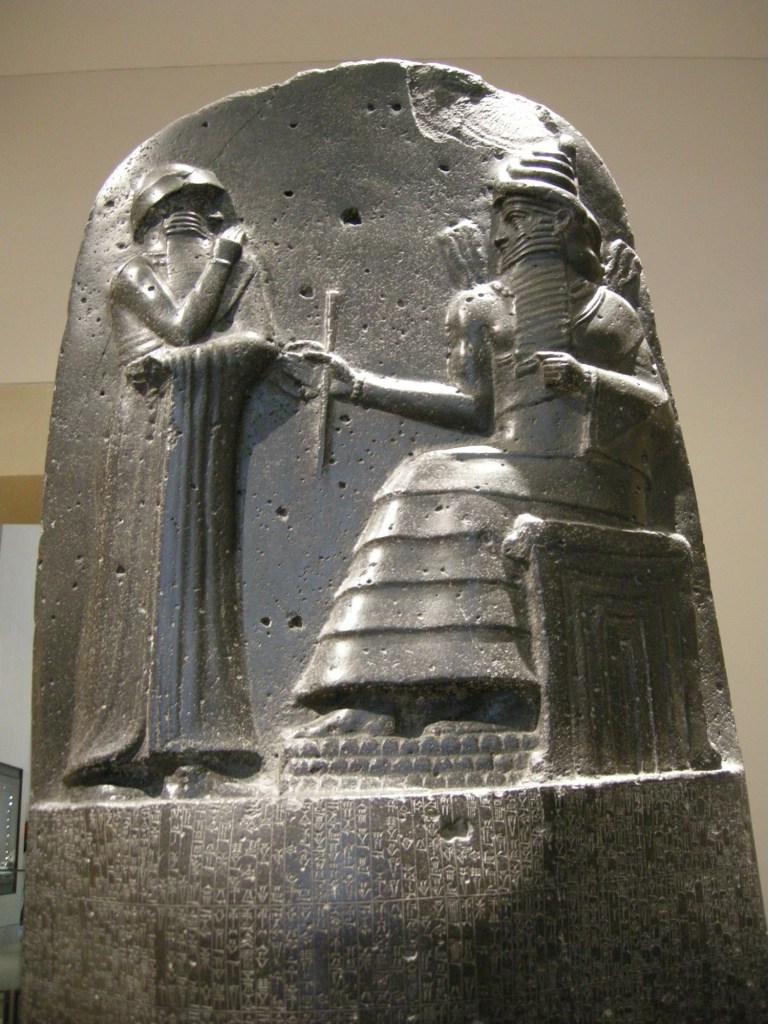
The top of the Code of Hammurabi stele, showing Hammurabi before Shamash, the Mesopotamian sun god associated with justice. Photo by Sailko, CC BY-SA 3.0, via Wikimedia Commons.
That mattered.
A king who could claim that justice stood behind him was not merely ruling by force. He was presenting himself as the guardian of order.
Was it really a “code”?
The phrase Code of Hammurabi is famous, but it can be a little misleading.
When modern people hear “code,” we may imagine a complete legal system, like a modern criminal code or civil code.
The Louvre is careful about this point. It says the text is not a “legal code” in the modern sense, but rather a broad collection of jurisprudence or case law, containing 282 legal judgements organized around areas such as family, property, trade, and labour.
That distinction matters.
The stele probably was not a full law book that every Babylonian citizen could pull from a shelf and use like a modern legal guide.
It was more like a royal statement of justice.
A public monument.
A declaration of how the king understood order, fairness, punishment, responsibility, and authority.
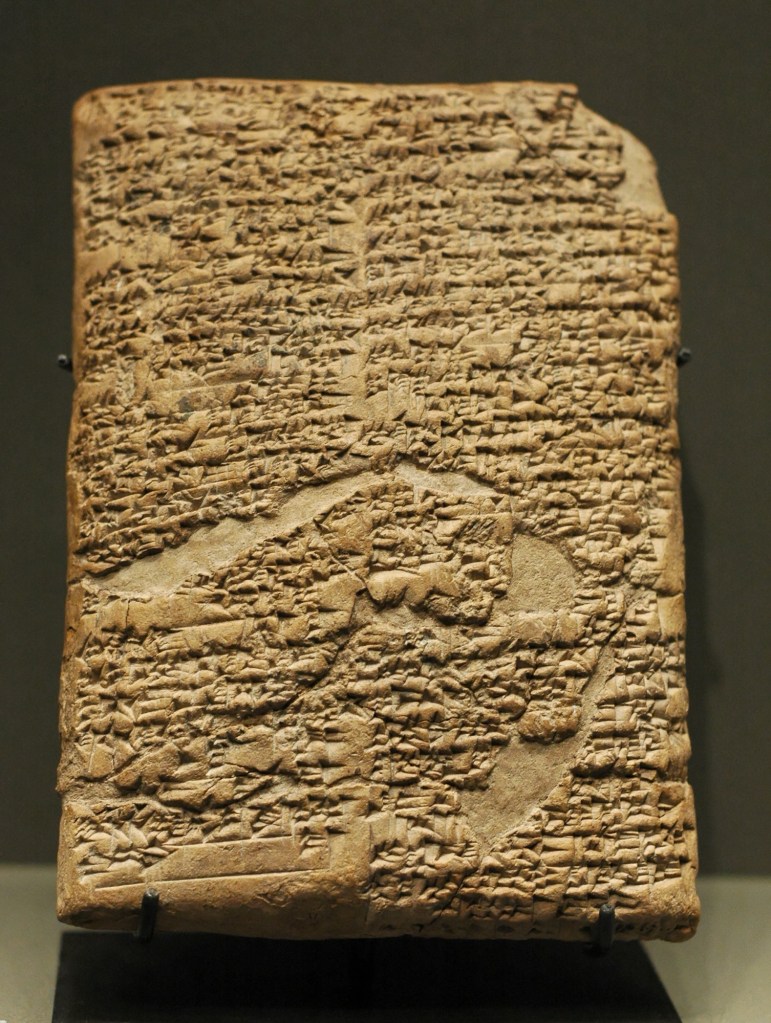
Clay tablet containing part of the prologue to the Code of Hammurabi. The tablet shows how Hammurabi’s legal tradition was preserved not only on the famous stele, but also through cuneiform copies. Public domain, via Wikimedia Commons.
That makes it even more interesting.
It was law, but it was also image.
It was policy, but it was also power.
“An eye for an eye”
The Code of Hammurabi is often remembered for one phrase:
An eye for an eye.
That idea is called lex talionis, or the law of retaliation. In simple terms, the punishment should reflect the injury.
If someone caused harm, the response should match the harm.
To modern readers, that can sound harsh.
And sometimes it was.
But in its ancient context, the idea also had a limiting function. It suggested that punishment should not be endless revenge. If a wrong was done, the response should be measured, not uncontrolled.
That does not mean the system was equal or fair by modern standards.
It was not.
Punishments could depend heavily on social status. The same injury might be treated differently depending on whether the person harmed was elite, common, enslaved, male, or female.
So the Code reveals both progress and inequality.
It tried to define justice.
But it did so within a deeply hierarchical world.
What kinds of laws did it include?
The Code of Hammurabi covered many areas of daily life.
Not just murder or theft.
It dealt with property, debt, wages, contracts, farming, marriage, divorce, inheritance, adoption, injury, trade, building work, medical treatment, and labour.
That range is important.
It tells us that ancient law was not only about dramatic crimes. It was about ordinary life.
What happens if a builder constructs a house badly and it collapses?
What happens if someone damages another person’s field?
What happens if a merchant breaks an agreement?
What happens when a family dispute becomes a legal problem?
These questions still sound familiar.
The details have changed, but the basic human problems have not.

Detail of the cuneiform inscription on the Code of Hammurabi stele. Photo by Deror avi, CC BY-SA 3.0, via Wikimedia Commons.
People still argue over property.
People still break contracts.
People still hurt one another.
People still ask who is responsible when something goes wrong.
That is why the Code of Hammurabi still feels strangely close, even across thousands of years.
Justice, but not equality
One of the most important things to understand about the Code is that it did not treat everyone the same.
Ancient Babylonian society was structured by class, status, gender, wealth, and freedom. The Code reflects that.
That can be uncomfortable to read.
But it is also historically important.
The Code of Hammurabi was not a modern human rights document. It did not imagine equality the way many people do today. It was a legal monument from a hierarchical ancient society trying to preserve order within that hierarchy.
This is where we have to hold two truths at once.
The Code is remarkable because it shows a society writing down legal principles, responsibilities, penalties, and protections.
But it is also limited because those protections were not shared equally.
That tension is part of what makes it worth studying.
It shows how old the dream of justice is.
And how long humans have struggled to make justice fair.
Why write laws in stone?
Writing law down changes its power.
A spoken rule can shift.
A private judgement can be hidden.
A ruler’s command can disappear when memory fades.
But a law carved into stone claims permanence.
It says:
This is order.
This is authority.
This is what the king wants remembered.
The stele itself was not just a storage device for legal information. It was a monument meant to be seen, respected, and remembered.
It told the people that the king stood for justice.
It told officials that judgement had a royal model.
It told future rulers that Hammurabi wanted his name linked with fairness and order.
That may be the deeper reason the Code survives in our imagination.
It was not just about laws.
It was about legacy.
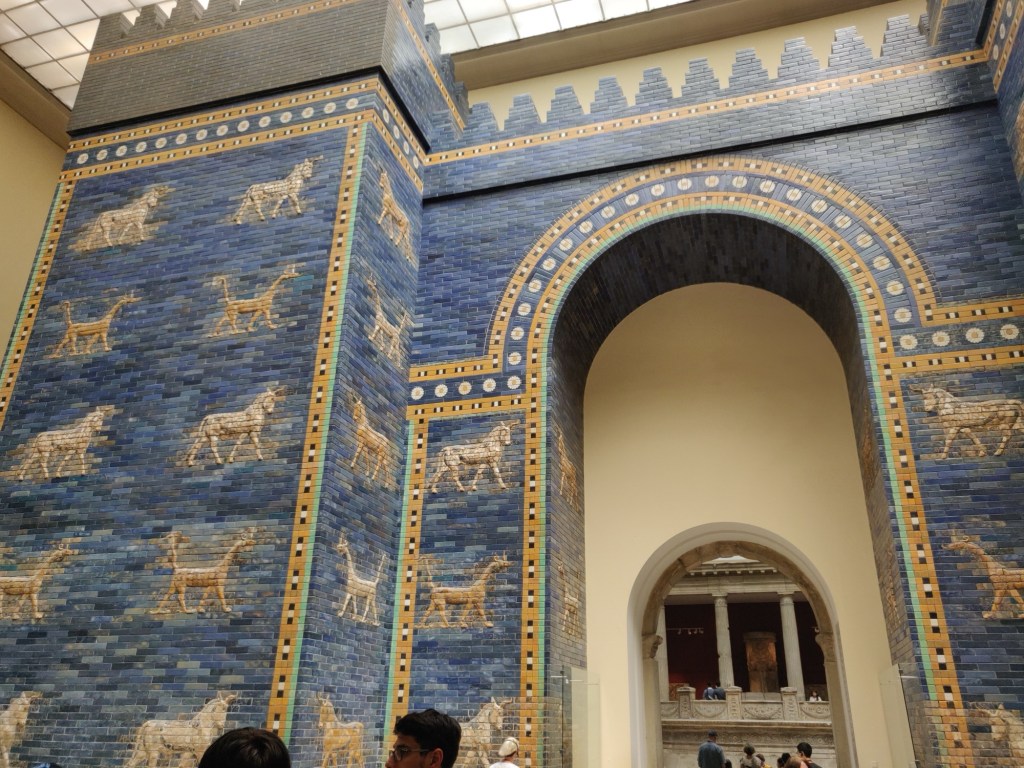
The reconstructed Ishtar Gate of Babylon at the Pergamon Museum in Berlin. Photo by Kurt Kaiser, CC0 / public domain dedication, via Wikimedia Commons.
The human need for rules
The Code of Hammurabi feels ancient because of its language, gods, punishments, and social world.
But its deeper concern is familiar.
- How do we stop the strong from crushing the weak?
- How do we settle disputes without endless revenge?
- How do we protect property, families, workers, and agreements?
- How do we make power answer to something beyond itself?
These questions are still with us and every society has to answer them.
Not perfectly.
Not permanently.
But somehow.
The Code of Hammurabi reminds us that law is one of humanity’s oldest tools for turning chaos into order.
It does not always succeed.
It can be unfair.
It can protect power as much as restrain it.
But the attempt matters.
Because without shared rules, every conflict risks becoming personal revenge.
Why the Code still matters
The Code of Hammurabi is not important because we should copy it.
We should not.
Its punishments were often severe, and its social assumptions were deeply unequal.
It matters because it shows an ancient society trying to make justice visible.
It shows a ruler presenting himself as responsible for protecting order.
It shows ordinary problems becoming legal questions.
It shows the ancient roots of a very modern belief:
That justice should not depend only on mood, strength, wealth, or private revenge.
It should be known.
It should be written.
It should be something people can point to.
Even if Hammurabi’s world did not achieve justice as we would define it today, it helped preserve one of history’s earliest and most powerful legal statements.
A society was saying:
- There must be rules.
- There must be consequences.
- There must be a way to decide.
Final thought
The Code of Hammurabi was carved into stone nearly 4,000 years ago, but the questions behind it have never really left us.
What is fair?
Who gets protected?
Who decides?
Should punishment match the harm?
Can written law restrain power, or does it sometimes preserve it?
Hammurabi’s answers belong to ancient Babylon.
But the need to ask those questions belongs to all of us.
That is why the Code still matters.
Not because it was perfect.
But because it reminds us that the search for justice is ancient, unfinished, and deeply human.
And now it’s your turn.
Do you think the Code of Hammurabi represents justice, control, or both?
Share your thoughts in the comments, and follow The Time Traveller’s Diary for more strange discoveries, historical anomalies, and forgotten clues from the past.
Discover more from The Time Traveller's Diary
Subscribe to get the latest posts sent to your email.
