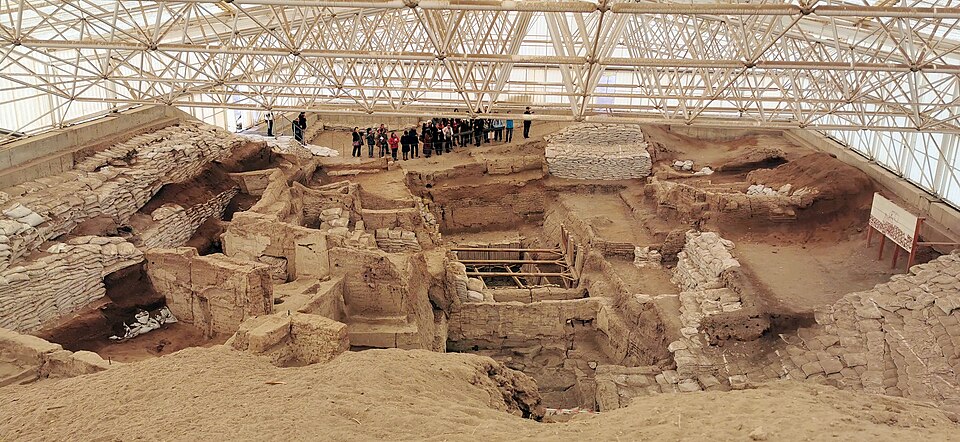
There was no front door. To get home, you climbed onto the roof, crossed over your neighbours’ houses, and lowered yourself down a ladder through a hole in the ceiling, past the smoke from the hearth below. Under the floor where you slept, the dead of the household lay buried. This was Çatalhöyük, a Neolithic settlement on the Konya Plain in what is now Turkey, and for roughly 2,000 years it was home to one of the largest settled communities of its time, without streets, without an obvious palace, and without a temple anyone has been able to identify.
A mound on the Konya Plain
Çatalhöyük is two mounds, rising up to 20 metres above the Konya Plain, southeast of the present day city of Konya. UNESCO, which listed the site in July 2012, dates 18 Neolithic levels on the Eastern tell to 7,400-6,200 BCE, and Chalcolithic levels on the Western tell to 6,200-5,200 BCE. Other chronologies differ, so treat single date pairs as approximate. People lived here, rebuilding on the same ground, for well over a thousand years as farming and settled life took hold.
As with the Göbekli Tepe post, the setting is Neolithic Anatolia, but the evidence here is domestic: houses, hearths, paintings, and burials, preserved because each generation built directly on the last.
Houses entered from the roof
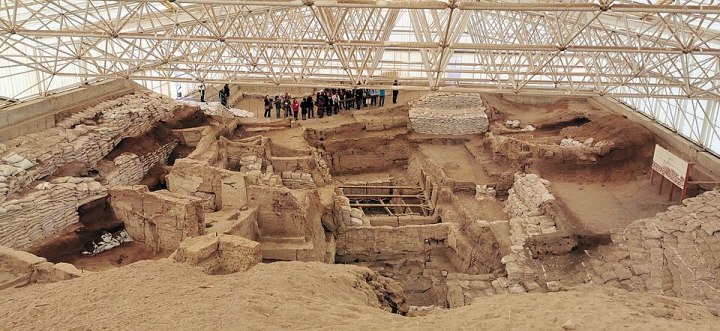
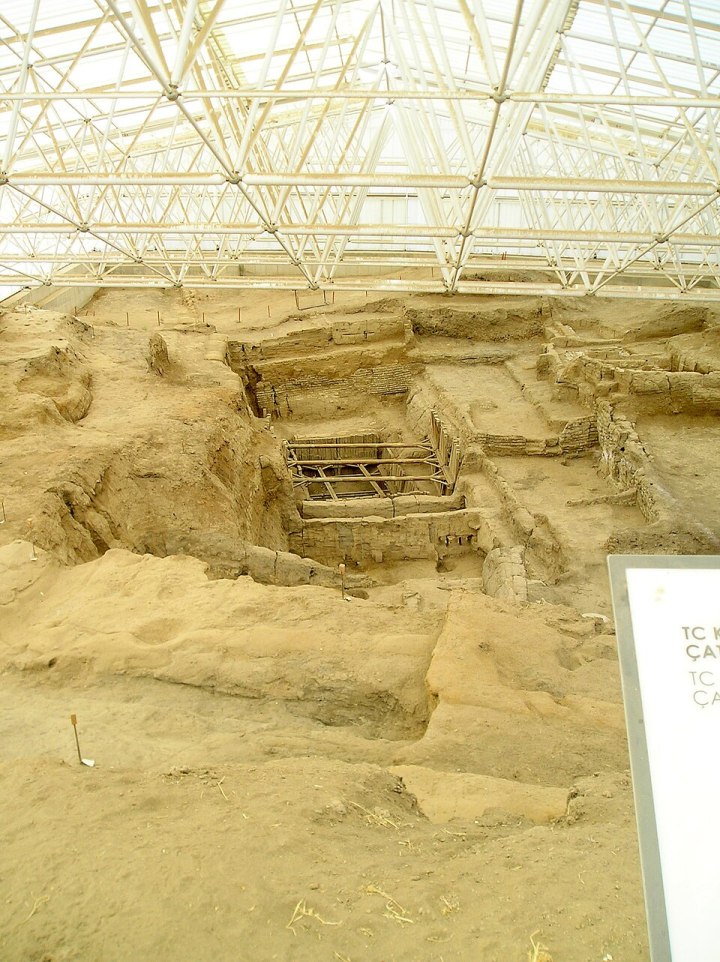
The houses were built back to back, wall against wall, with no streets, footpaths, or alleys between them. UNESCO’s citation singles out “streetless neighbourhoods” and “dwellings with roof access”. Most houses were reached through a roof opening, down a wooden ladder. The opening let in light and let out smoke from the hearth and oven below. The rooftops, in effect, were the streets.
Inside, a typical house had plastered walls, raised platforms, and smaller storage rooms reached through low openings. Floors and walls were replastered again and again, rooms were kept clean, and rubbish went to middens outside. When a house ended, a new one rose on the rubble, on much the same footprint. Layer upon layer, that cycle built the mound.
Population estimates vary widely. Older work put the average at 5,000 to 7,000. Recent work suggests far fewer in one phase, as few as 600 to 800 on the East Mound in an average year, while other summaries give 3,000 to 8,000 at peak. Treat any headcount as a phase-specific estimate, not a census.
Painted walls, cattle heads, and the dead under the floor
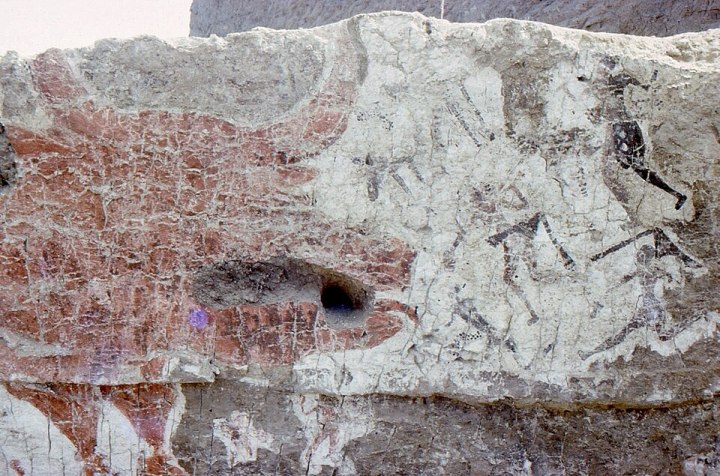
Walls carried vivid paintings and reliefs: hunting scenes, red images of aurochs (wild cattle) and stags, geometric patterns, handprints, and vultures swooping over headless figures. Heads of animals, especially cattle, were mounted on walls. Some paintings were plastered over and repainted, so one wall can hold images from many years.
The dead stayed close. Remains have been found in pits beneath floors, especially beneath hearths, platforms, and beds. Bodies were usually tightly flexed, often in baskets or wrapped in reed mats. Some heads were later removed, and some skulls were plastered and painted with ochre to recreate faces. Clay figurines and obsidian tools were also found.
No obvious public buildings have been identified, and no identifiable temples have been found. Some richly decorated rooms may have been shrines or meeting areas, but that remains an interpretation. Houses were broadly similar in size, which UNESCO reads as a layout based on egalitarian ideals, yet decoration and burials varied by household.
Two excavations, sixty years apart
British archaeologist James Mellaart discovered the site in 1958, during a survey of the Konya Plain, and led four excavation seasons between 1961 and 1965. He exposed successive layers of buildings, paintings, and burials. Mellaart was barred from further excavation at Çatalhöyük following the Dorak affair, in which he published drawings of a Bronze Age treasure that was never located, and the site lay idle for nearly thirty years.
Work resumed in 1993 under Ian Hodder, then at Cambridge and later at Stanford. After two survey seasons, excavation began in 1995. Hodder’s team worked far more slowly, spending whole seasons on single buildings. The 25 year project ended under Hodder in 2018, and Turkish-led excavation has continued. The second excavation also matters because a 2018 examination of Mellaart’s papers found evidence that some of the wall-painting reconstructions he published in the 1980s and 1990s were fabricated.
A volcano, or a leopard skin?
Mellaart read the Level VII painting, dated to around 6,600 BCE, as a town plan beneath the twin peaks of an erupting volcano, Hasan Dağı. On that reading it is often cited as the world’s oldest map. Stephanie Meece has argued instead that the spotted upper shape is a leopard skin, and the lower pattern a decorative design. A 2014 study (Schmitt and colleagues, PLoS ONE) dated an explosive eruption of Hasan Dağı to about 6,960 BCE, plus or minus 640 years, overlapping Level VII, and concluded the geology supports the volcano reading. That supports Mellaart’s case without settling it. The original is now in the Museum of Anatolian Civilizations in Ankara.
The House of the Dead?
In August 2025, reports complicated the “no public buildings” picture. Excavations led by Prof. Dr. Arkadiusz Marciniak of Poznań University found a cluster of structures around a courtyard. One building seemed to have no domestic layers, and beneath its floor were the remains of 20 individuals, who the team suggested likely died elsewhere and were ceremonially brought there. Later reporting in 2026 gave 18 burials for the same structure, identified as Building 173. It was dubbed the “House of the Dead” or “Spiritual House”. A large painted building with fourteen platforms stood nearby, awaiting further excavation.
This find is reported, not yet settled. The announcements came through archaeology news outlets citing Poznań University, radiocarbon dating was pending, and later reporting gave a different burial count. If the mortuary reading holds, it would be the clearest non-domestic building yet found here. It would not by itself prove temples, priests, or rulers.
A sentence worth pausing on
“the most significant human settlement documenting early settled agricultural life of a Neolithic community.”
UNESCO World Heritage Centre, on the Neolithic Site of Çatalhöyük.
What we know / What we don’t know
What we know:
- Two mounds on the Konya Plain; UNESCO dates 18 Neolithic East Mound levels to 7,400-6,200 BCE.
- Houses wall to wall with no streets, entered mainly through roof openings by ladder, hearths and ovens below.
- Paintings and reliefs on walls, cattle heads mounted on walls, the dead buried beneath floors and platforms.
- Found by Mellaart in 1958, dug by him in 1961-1965; Hodder’s project ran 1993-2018; UNESCO listed the site in July 2012.
- A possible mortuary building, the “House of the Dead”, reported in August 2025, with 18 to 20 individuals beneath its floor, depending on the report.
What we don’t know:
- How many people lived there at once: hundreds in one phase to several thousand at peak, depending on method.
- Why no streets or ground-level doors. Defence, custom, and climate have been suggested; none is proven.
- What the paintings meant, including whether the Level VII image is a volcano, a leopard skin, or something else.
- How decisions were made, and whether no palaces means equality or authority that left little trace.
- Why occupation moved from the East Mound to the West Mound, and why the roof-walking life ended.
- Whether the “House of the Dead” reading survives dating and further digging.
Key takeaways
- Çatalhöyük was a town without streets: neighbours shared walls, and movement ran across rooftops and down ladders.
- Home, art, and burial shared rooms: paintings, cattle heads, hearths, and graves all belonged inside the house.
- No palace or identified temple has been found, challenging simple stories about towns and rulers going together.
- Two very different excavations stand behind the story, and the careful second one is why earlier claims carry caveats.
- The story is still moving: the reported 2025 mortuary building needs fuller publication before being treated as final.
And now it’s your turn
Was Çatalhöyük proof that thousands of people could live together for centuries without kings, temples, or streets, or are we mistaking missing evidence for absent rulers? If the “House of the Dead” proves to be a shared, purpose-built structure, does it point to a community organized around households and shared ritual, or to the public buildings we thought were missing? Tell us where you land, and what would change your mind.
Discover more from The Time Traveller's Diary
Subscribe to get the latest posts sent to your email.
