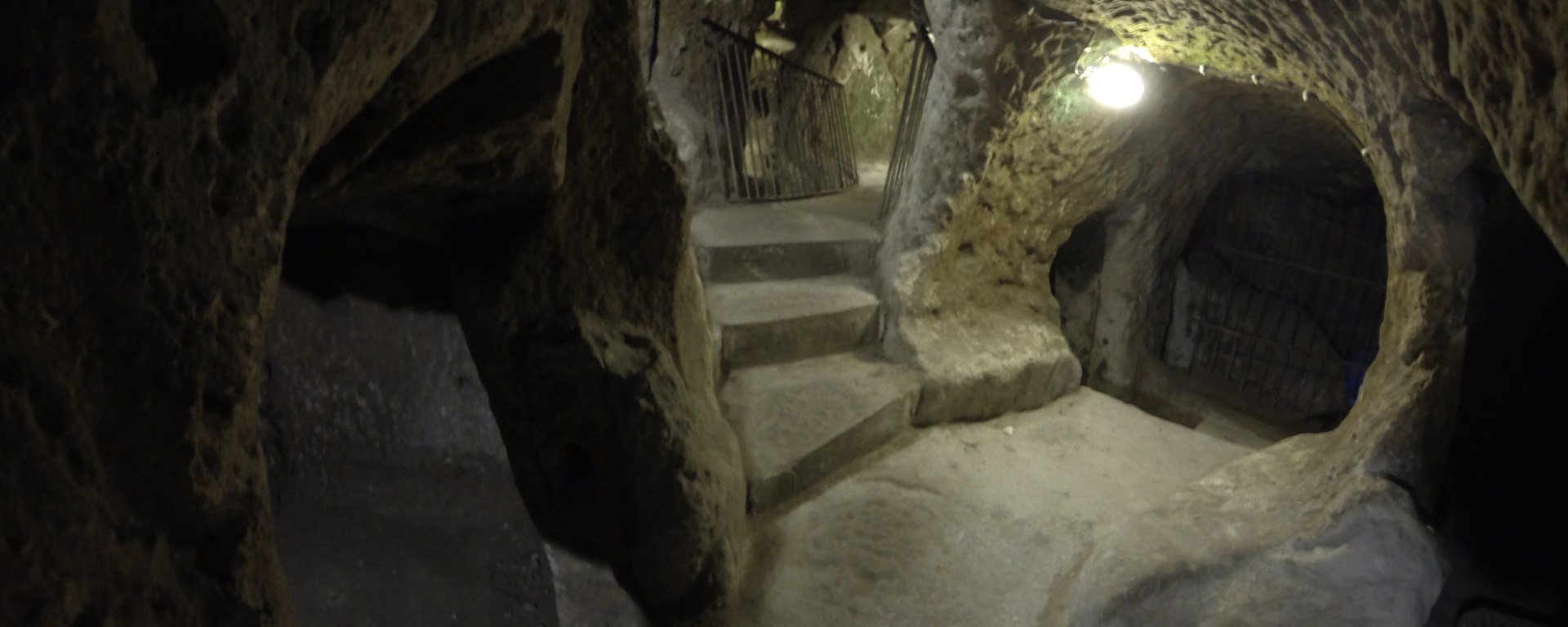
Beneath the streets of an ordinary town in Cappadocia, in central Turkey, rooms and passages run down through soft volcanic rock into a complex estimated to reach about 85 metres at its deepest point. According to the Turkish Ministry of Culture and Tourism, only about one tenth can be visited. The rest stays closed. That is Derinkuyu: a second town under the first, built for hiding, not for display. Who needed a place like this, and what were they hiding from?
Carved from ash
Derinkuyu lies beneath the modern town of the same name, in Nevşehir Province. The name is usually translated as “deep well”, and Cappadocian Greek speakers knew the place as Malakopi. The complex was carved into tuff, a soft rock formed from compacted volcanic ash, which can be cut with hand tools and still holds rooms and passages open. This made it possible to carve extensive underground dwellings throughout Cappadocia.
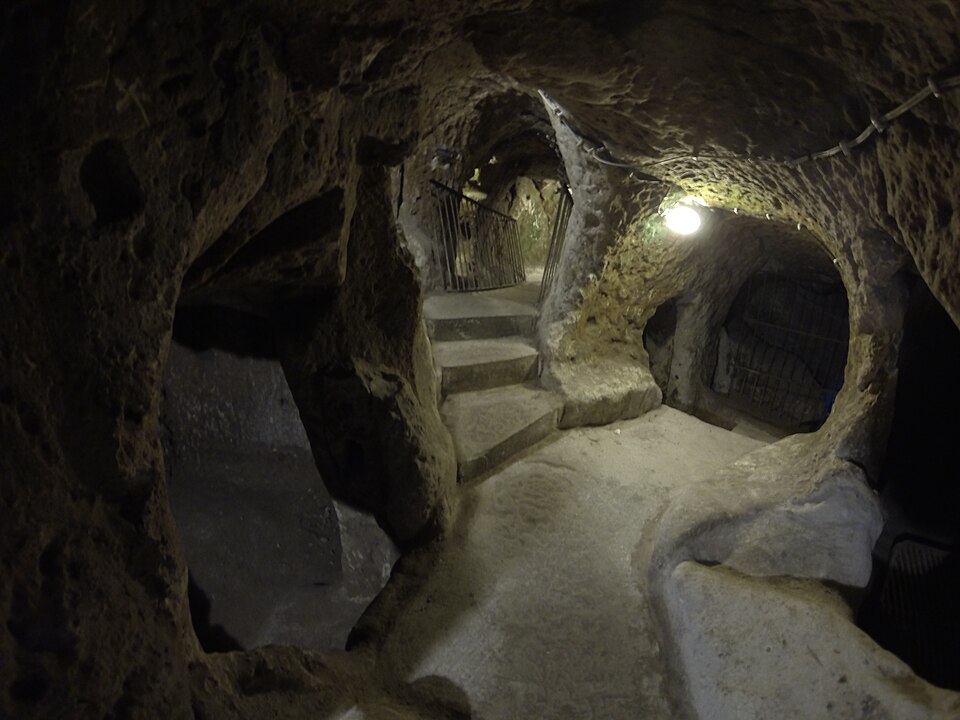
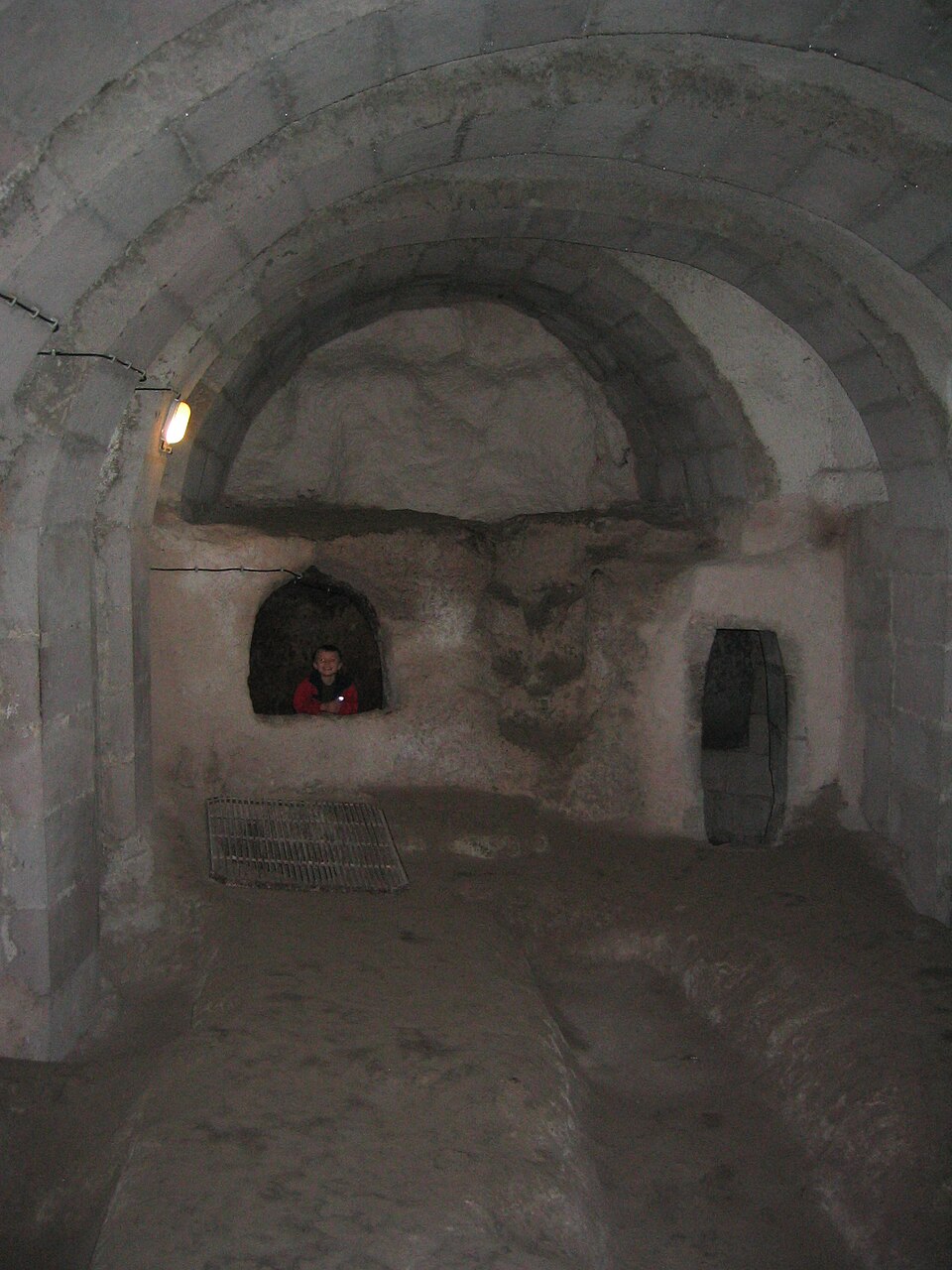
The Turkish Ministry of Culture and Tourism estimates that Cappadocia holds between 150 and 200 underground settlements of various sizes. Derinkuyu is one of the largest known underground cities in Cappadocia, with rooms joined by galleries and tunnels. The Ministry describes stables near the entrances and shared kitchens with tandoor ovens as features of Cappadocia’s underground settlements. At Derinkuyu, cellars, dining halls, churches, grape processing rooms and a room identified as a missionary school helped meet the needs of a large community.
Historical accounts describe underground chambers in Cappadocia being used as refuges during times of danger. You will often read that Derinkuyu has 18 levels and room for as many as 20,000 people, along with livestock and supplies. Both figures are estimates. The Turkish Museums listing describes eight levels, while the district government estimates that the complete complex may have 12 or 13. The municipal government gives an estimated population of 20,000.
Built to close, built to breathe
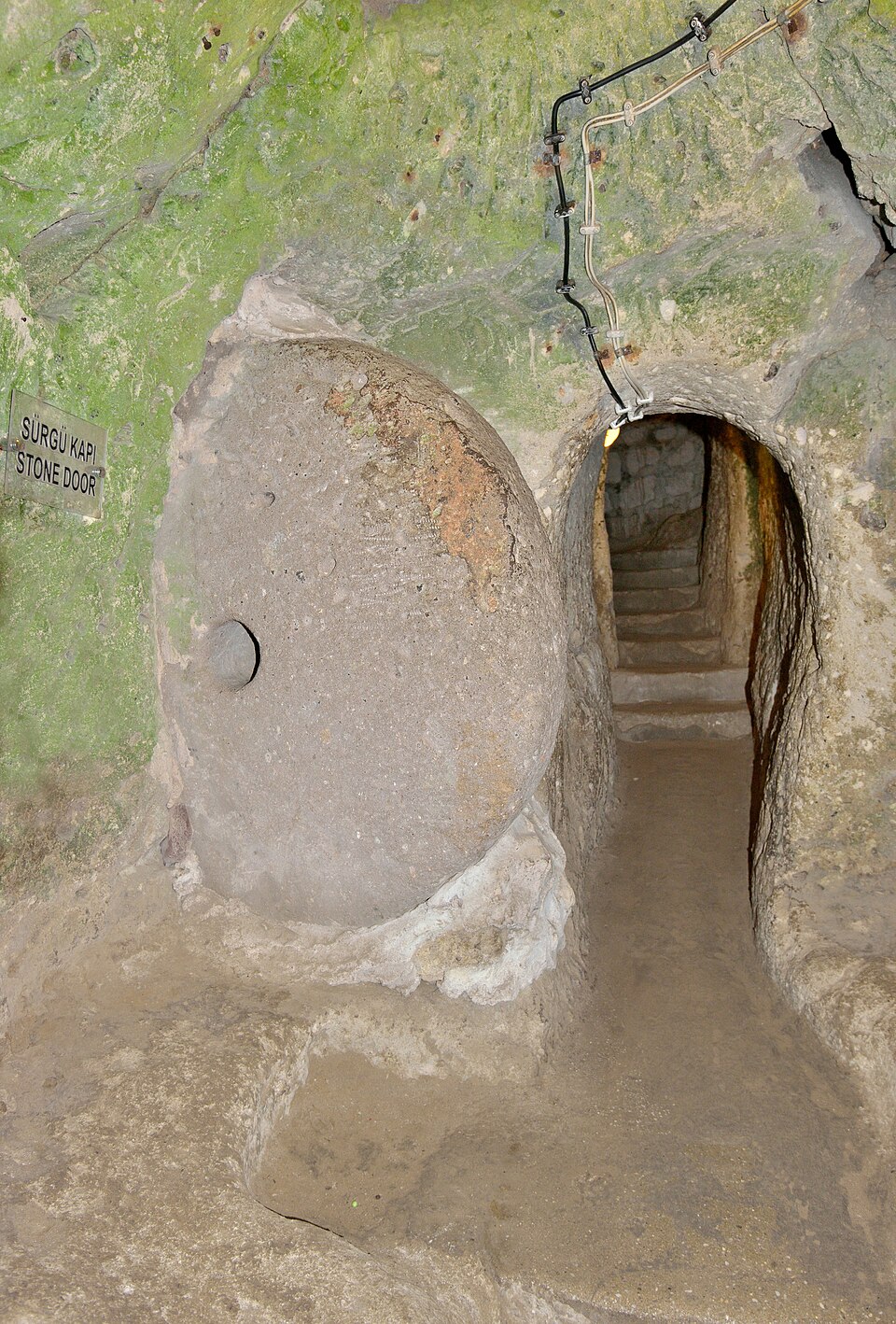
The defensive system worked from the inside. Large rolling stone doors could close passages, creating successive barriers against intruders.
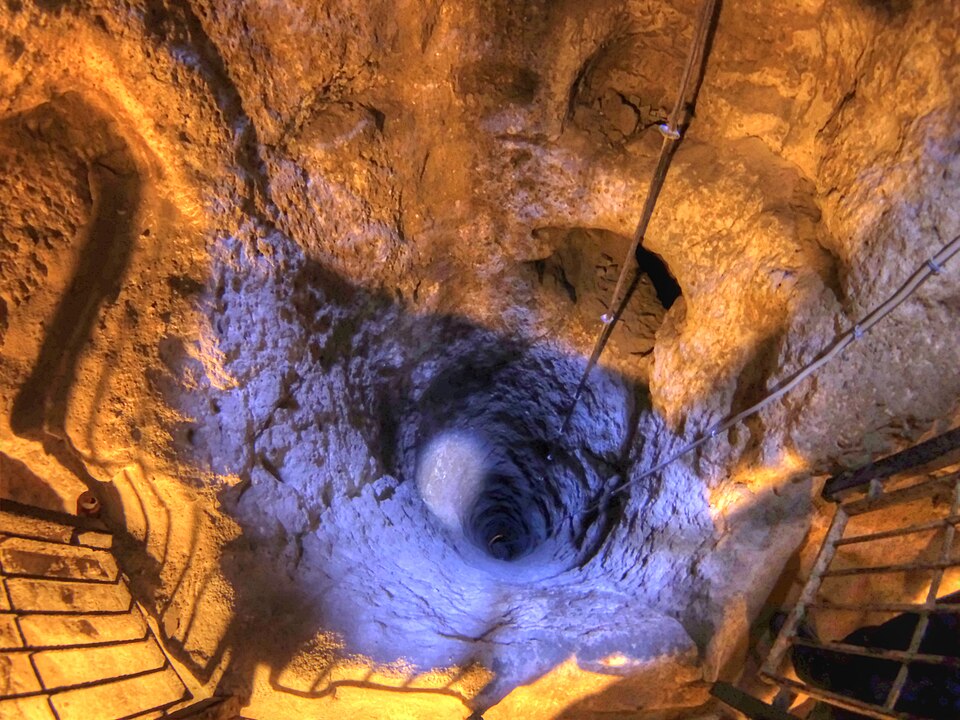
Air and water set the real limits on hiding underground. Derinkuyu has a network of vertical ventilation shafts, and the Ministry museum page describes one shaft 55 metres deep, connected to the surface and also used as a water well. The Ministry also describes wells without surface openings, intended to prevent their water from being poisoned during an invasion. Access to air and water was essential for people sheltering underground.
The layout suggests that people sheltering below ground shared resources and facilities. Derinkuyu was designed to accommodate a community, rather than simply provide individual hiding places. The spacious barrel-vaulted room on the second floor is reported to have been a religious school, with study rooms beside it. That use is reported, not proven.
Who dug it, and who hid in it
Some accounts attribute the earliest excavations to the Phrygians, while others propose an earlier Hittite origin. Neither claim rests on an inscription or a contemporary record naming the builders, and none was found during research for this post.
What is better documented is later use. UNESCO identifies Derinkuyu and Kaymakli as underground towns used for refuge against Arab incursions during the Byzantine era. In his 1916 book, the linguist R. M. Dawkins described underground galleries at Malakopi, now Derinkuyu. He also recorded villagers at nearby Axo taking refuge underground after news of the 1909 massacres at Adana.
During the population exchange between Greece and Turkey in 1923 and 1924, the region’s Greek Orthodox inhabitants were required to leave for Greece. Historical summaries associate their departure with the abandonment of the underground city, although the precise date is uncertain. Knowledge of the full complex then faded. The modern story starts, in the repeated account, with a wall. The Derinkuyu district government records an accidental discovery in 1963. EarthDate, from the University of Texas at Austin, tells it plainly: in 1963, a homeowner renovating a basement knocked down a wall and uncovered a tunnel leading to the underground city. No contemporary record identifying the homeowner or confirming the circumstances was found.
The Ministry dates the public opening to 1965 and states that about ten percent can be visited. The district government gives a different opening year, 1967. In 1985, UNESCO inscribed Göreme National Park and the Rock Sites of Cappadocia as a World Heritage property, naming Derinkuyu and Kaymakli among its subterranean cities.
In later periods, in order to resist Arab invasions, they began banding together into troglodyte villages or subterranean towns such as Kaymakli or Derinkuyu which served as places of refuge.
UNESCO World Heritage Centre, on Göreme National Park and the Rock Sites of Cappadocia
The same fear, a different answer
The need for refuge that Derinkuyu reflects has not gone away. People are still digging for safety, and they are answering it in two very different ways.
The first answer is Finland. Beneath Helsinki, a city of roughly 700,000 people, there are around 5,500 civil defence shelters with space for approximately 900,000 people. Across Finland there are around 50,500 shelters, with space for about 4.8 million people. Shelter construction resumed in 1955, and Finnish law requires shelters in qualifying buildings. They must be capable of activation within 72 hours. In peacetime some serve as swimming pools, gyms, playgrounds, car parks, and metro stations. The Itäkeskus Swimming Hall, under some 50 metres of solid rock, welcomes around 375,000 visitors a year, according to the January 2026 report. According to the hall’s manager, many visitors think of it simply as an underground swimming pool.
The second answer is private. In December 2024, the Associated Press reported that Ron Hubbard, CEO of the Texas-based Atlas Survival Shelters, said four customers bought bunkers on November 21, following Russia’s first use of an experimental hypersonic ballistic missile against Ukraine. Hubbard also reported selling at least one bunker on most days. His customers, he explained, wanted somewhere safe for their families.
Derinkuyu offers a different perspective. Its builders provided more than defensive walls and concealed entrances. The complex contained ventilation shafts, wells, kitchens, storage rooms and spaces for communal activities. These features suggest that sustaining a community during danger mattered alongside keeping intruders out.
Helsinki offers a modern example of shared preparedness, with some shelters forming part of everyday community life. Private bunkers offer a different approach, centred on protecting households. Derinkuyu raises a question relevant to both: what do people need from a refuge beyond protection from the immediate danger?
What we know / What we don’t know
What we know
- Derinkuyu is a multi-level underground complex beneath the town of Derinkuyu in Cappadocia, carved into soft volcanic tuff.
- Ministry publications describe an approximate overall depth of 85 metres, a 55-metre ventilation shaft that also served as a well, and about ten percent of the complex open to visitors.
- Derinkuyu contains stables, cellars, dining halls, churches and grape processing rooms. The Ministry identifies a second-floor room as a missionary school.
- UNESCO identifies Derinkuyu as a refuge used against Arab incursions during the Byzantine era.
- The population exchange between Greece and Turkey began in 1923. The wider Cappadocia property was inscribed by UNESCO in 1985.
- Helsinki has around 5,500 civil defence shelters with approximately 900,000 places. Finland has around 50,500 shelters nationwide, with space for about 4.8 million people.
- In December 2024, the Associated Press reported Ron Hubbard’s account of selling four bunkers on November 21, following a Russian missile strike on Ukraine.
What we don’t know
- Who first cut the complex, and when. The Phrygian attribution is claimed but not proven.
- The true number of levels and the true capacity. The Ministry describes eight levels, the district government estimates 12 or 13 in total, and other accounts give 18. The estimated population of 20,000 has not been independently established.
- Whether a tunnel to Kaymakli exists as one continuous passage. The claim is often repeated, but no official survey confirming it was found.
- The details of the 1963 rediscovery. The district government records an accidental discovery, but the homeowner’s identity and the circumstances of the wall story remain unconfirmed.
- How many people sheltered there at any one time, and for how long. No historical population record confirming the capacity estimate was identified.
- The full extent beyond the visitable tenth. What lies in the closed sections is not settled in the sources checked.
- The precise abandonment and opening dates. Historical summaries differ on abandonment, while official government sources give both 1965 and 1967 for the public opening.
Key takeaways
- Derinkuyu is best understood as a complex that served as a refuge during times of danger.
- The scale is real, but the headline numbers, 18 levels and 20,000 people, are estimates.
- The origins are debated. The Byzantine refuge use is the documented part of the story.
- Most of the complex remains closed to visitors, and its full extent remains uncertain.
- The accidental discovery in 1963 is officially recorded, but the homeowner’s wall story remains unconfirmed.
- Modern approaches to preparedness range from Finland’s extensive civil defence shelter system to privately purchased bunkers.
- Derinkuyu suggests that a refuge must address people’s practical needs as well as provide protection.
And now it’s your turn
Derinkuyu was built to shelter a community. When we prepare for danger today, should protecting the household or protecting the wider community come first?
Discover more from The Time Traveller's Diary
Subscribe to get the latest posts sent to your email.
