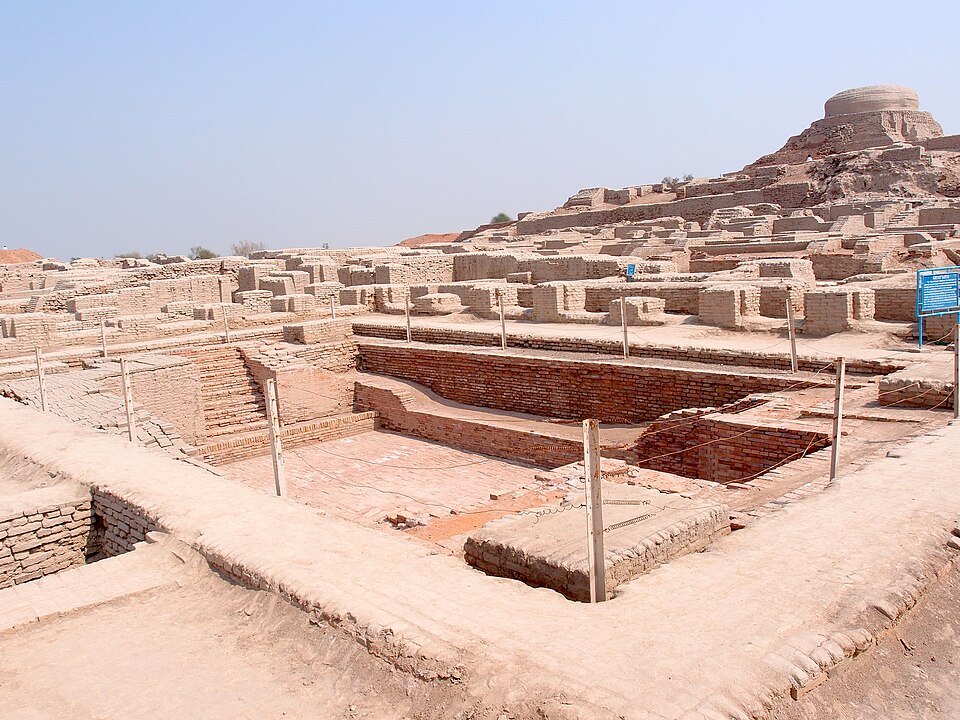
Imagine stepping off a dusty track in Sindh, in present-day Pakistan, and walking into a city that is more than 4,000 years old.
The streets run straight. They cross at right angles. The houses are brick, solid, and built to a pattern you start to recognise after only a few turns. And beneath your feet, not as an afterthought but as part of the design, runs a covered drain.
This is Mohenjo-daro, one of the great cities of the Indus Valley Civilization, also called the Harappan Civilization. At its mature peak, roughly 2600 to 1900 BCE, it stood alongside Egypt and Mesopotamia as one of the great Bronze Age worlds. Yet it breaks almost every rule we expect from an ancient superpower.
Egypt gave us pyramids and pharaohs whose names we still recite. Mesopotamia gave us palaces, temples, and kings carved into stone. Mohenjo-daro gave us something stranger, and in some ways more impressive: a city that worked, brilliantly, without leaving us a king to remember, a palace to point to, or a single sentence we can read.
That is the mystery. Not a lost treasure, or a single vanished ship, but an entire civilization that we can map, measure, and walk through, and still cannot hear.
A city built like a plan, not an accident
Mohenjo-daro was not a village that grew messy and large. It was laid out.
The city divides into two main parts: a raised Citadel mound on the west, holding its largest public structures, and a much larger Lower Town of homes, workshops, and lanes below it. The streets follow a grid, roughly north-south and east-west, wide enough for carts in the main thoroughfares, with smaller lanes branching off at right angles.
The bricks tell the same story. Across the Indus region, builders used standardized fired bricks, commonly in a 1:2:4 ratio of thickness to width to length. That kind of consistency, over hundreds of kilometres, does not happen by chance. It points to shared standards, shared measures, and a society that could coordinate work at scale, even if we cannot name the people doing the coordinating.
Then there is the water. Mohenjo-daro is famous, rightly, for its drains.
Covered brick drains ran along almost every street, with removable covers so they could be inspected and cleaned. Houses commonly had their own bathrooms and toilets, draining into those street channels, which in turn fed soak pits and larger drains. More than 700 wells have been identified at the site, giving households and neighbourhoods their own clean water.
Pause on that for a moment. In a world where most later cities would let waste run in open gutters for another two thousand years, Mohenjo-daro was already treating sanitation as infrastructure. It was not glamorous. It was not built to impress a god or glorify a ruler. It was built to keep a city of tens of thousands of people (estimates vary, but 30,000 to 40,000 is commonly cited) healthy, supplied, and functioning.
That ordinariness is the point. The most remarkable thing about Mohenjo-daro may not be a monument at all. It may be the drains.
The Great Bath: the biggest mystery in plain sight
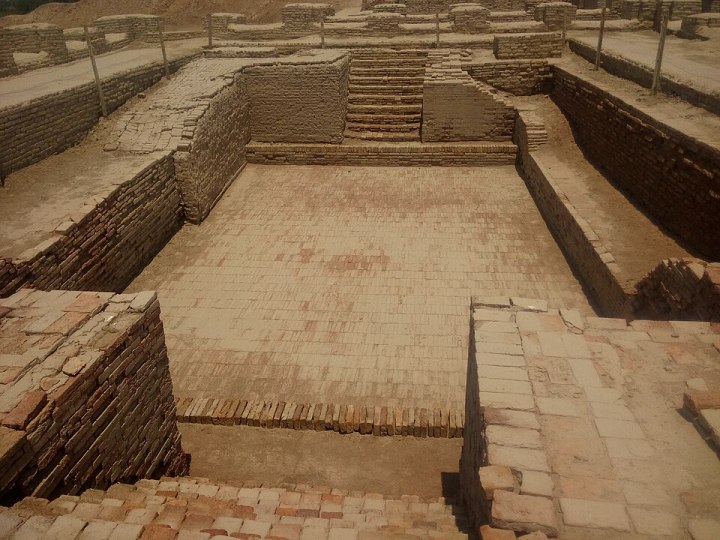
On the Citadel mound sits the structure every visitor asks about: the Great Bath.
It is a rectangular, watertight tank, roughly 12 metres long, 7 metres wide, and about 2.4 metres deep, built of finely fitted fired brick and sealed with bitumen so it would not leak. Steps lead down into it. Rooms and passages surround it. Water could be let in, and drained away.
What was it for? We do not know, not with certainty.
Many scholars think it was used for ritual bathing or some civic or ceremonial purpose, and that reading fits its care, its scale, and its position in the city. But no inscription at the Bath, or anywhere else at Mohenjo-daro, explains it. There is no plaque, no dedication, no king’s name carved beside the steps.
That absence runs through the whole site, and it is what separates Mohenjo-daro from its contemporaries. In Egypt, a great building usually tells you who ordered it. In Mesopotamia, a temple or palace usually tells you whose god, or whose reign, it served. At Mohenjo-daro, the greatest building tells us how well its builders could seal a tank, and leaves the why to us.
No palace, no king: what that does, and does not, prove
Here is the claim you will see repeated everywhere about the Indus cities: no palace, no royal tomb, no standing army, no named ruler.
As a description of what has been securely identified so far, that is broadly fair. No building at Mohenjo-daro has been securely identified as a conventional royal palace. No royal burial complex has been found. No inscription has been securely read as naming a Mohenjo-daro king, a royal office, or a god in the way Egyptian and Mesopotamian records do.
But this matters, because this site separates evidence from speculation: absence of evidence is not the same as proof of absence.
Only a portion of Mohenjo-daro has been excavated, and the script that might name its rulers cannot yet be read. Some scholars argue for corporate or council-style governance: merchants, priests, clan leaders, or guilds sharing authority, rather than a single divine king. Others caution that elite or palatial institutions could have looked different here, and that we should not mistake an unfamiliar form of power for no power at all.
What we can say, with confidence, is this: whatever ran Mohenjo-daro, it did not advertise itself the way Egypt and Mesopotamia did. It did not build its authority into towering tombs or triumphal art. It built it into streets, drains, weights, measures, and trade.
That is a different kind of power. It is quieter. It is also, in a modern city, strangely familiar: the power of a system that works even when you cannot name the person in charge.
A script we can see, but cannot read
Mohenjo-daro’s silence has a physical form: small, square steatite seals, pottery, and tablets covered in neat, tiny signs.
More than 4,000 inscribed objects from Indus sites have been recovered. The script uses several hundred distinct signs (estimates commonly fall in the 400 to 600 range, depending on how signs are counted). The inscriptions are short, often only about five signs, with the longest known running to roughly two dozen.
And no one has deciphered it.
That is not for lack of trying. Scholars have proposed Dravidian and other linguistic links, and others have debated whether the signs form a full writing system in the usual sense at all. What is missing, above all, is a bilingual key: a text in both Indus script and a known language, of the kind that unlocked Egyptian hieroglyphs.
If you have read the Diary’s Rosetta Stone post, this is the contrast worth holding onto. The Rosetta Stone gave us the same decree in three scripts, including Greek. Mohenjo-daro gives us thousands of messages with no translation attached. We can see the handwriting. We cannot hear the voice.
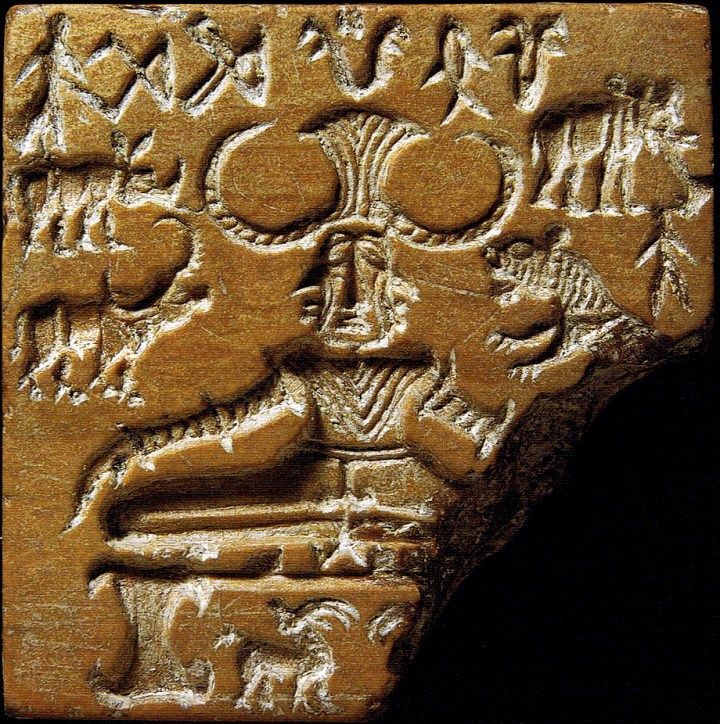
That is why we do not know the Indus word for king, or god, or home. It is why we do not know their laws, unlike Hammurabi’s Babylon, where law was carved, in readable form, onto a stone monument for all to see. At Mohenjo-daro, law, religion, history, and trade agreements may all be sitting in plain sight, on seals the size of a postage stamp, waiting for a key we do not have.
How a city like this fades
So how does a city this organised fade?
Not, on current evidence, in a single Hollywood moment. There is no well-supported story of a sudden invasion sweeping Mohenjo-daro away. The older invasion theory, once popular, is not supported by the archaeological evidence for a mass violent destruction at the time of decline, and the timeline does not fit neatly either.
What the evidence points to instead is slower, and more unsettling: a gradual unravelling from about 1900 BCE.
The climate grew drier. River systems shifted, including the drying of the Ghaggar-Hakra system, which had supported many Indus settlements. Floods still struck the Indus floodplain. Trade networks, including long-distance trade with Mesopotamia, where Indus seals have been found, and where Mesopotamian texts refer to a rich eastern land called Meluhha, very likely the Indus region, weakened as conditions changed.
In the late phases at Mohenjo-daro, building standards fall. Drains are left blocked. Fine houses are subdivided into workshops. The city does not fall in a day. It stops being maintained, stops being coordinated, and people drift toward smaller, rural settlements.
It is not a story of a single villain. It is a story of a system under pressure from climate, water, and trade all at once, until the thing that made the city remarkable, its coordination, could no longer hold.
That should feel uncomfortably relevant. Mohenjo-daro did not fail because it lacked engineering. It failed, in part, because the rivers and rainfall its engineering depended on changed.
Why Mohenjo-daro still matters
Mohenjo-daro was inscribed as a UNESCO World Heritage Site in 1980, as the Archaeological Ruins at Moenjodaro. Today its bricks face a quieter, modern threat: salt rising through the soil, groundwater, and flood damage. Conservation is not an abstract concern here. The record itself is fragile.
And yet the city still teaches a lesson that cuts against our usual history of greatness.
We tend to measure a civilization by its monuments: the tallest tomb, the grandest temple, the most famous king. Mohenjo-daro asks us to measure it differently: by whether ordinary people had clean water, by whether a street drained properly, by whether a brick made in one town matched a brick made hundreds of kilometres away.
By that measure, it was one of the most successful cities of the Bronze Age.
Key takeaways
- Mohenjo-daro, in Sindh, Pakistan, was a major city of the Indus Valley / Harappan Civilization, at its mature peak roughly 2600 to 1900 BCE.
- It was grid-planned, with standardized bricks, covered street drains, household bathrooms, and more than 700 wells identified.
- The Great Bath, about 12 by 7 metres and 2.4 metres deep, was watertight and bitumen-sealed; its exact purpose is still debated.
- No palace, royal tomb, or named ruler has been securely identified, but that is a limit of the evidence, not proof that no rulers existed.
- The Indus script, on more than 4,000 objects, remains undeciphered, with no bilingual key like the Rosetta Stone.
- The decline from about 1900 BCE looks gradual and multi-causal: climate drying, river shifts, floods, and trade disruption, not a single invasion.
So here is the question to leave you with:
If a civilization can build a city this well, and still leave us no name, no palace, and no readable word: what does that say about what we choose to remember, and what we choose to build to be remembered by?
Share your thoughts in the comments, and follow The Time Traveller’s Diary for more strange discoveries, historical anomalies, and forgotten clues from the past.
Until next time, keep exploring the mysteries of the past.
Discover more from The Time Traveller's Diary
Subscribe to get the latest posts sent to your email.
