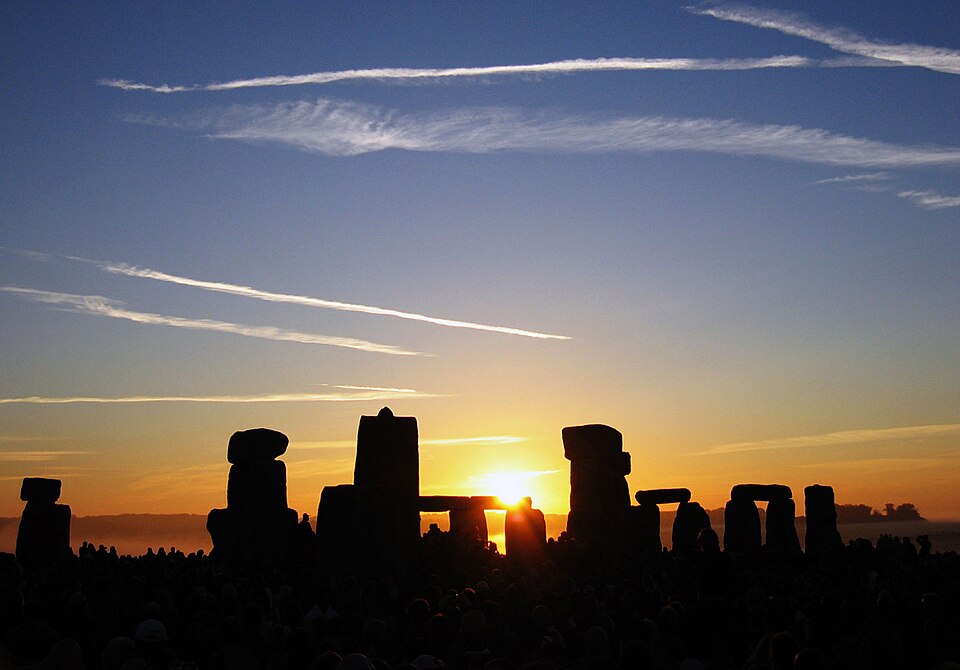
Stonehenge has always looked like a question carved into the landscape.
Who built it? Why here? How did people without engines, cranes, or modern roads raise stones so massive that even today they seem almost impossible to move?
But hidden near the centre of the monument is one stone that may be stranger than all the rest.
It is called the Altar Stone.
Unlike the towering sarsen stones that make Stonehenge instantly recognizable, the Altar Stone lies partly buried, almost forgotten, at the monument’s heart. It does not dominate the skyline. It does not appear in most photographs. For centuries, it was assumed to be just another local stone.
That story has now changed.
In August 2024, a study in Nature by Anthony Clarke and colleagues traced the Altar Stone not to Wales, but much farther away, to the Orcadian Basin in northeast Scotland, at least 750 kilometres from Salisbury Plain. The paper is titled “A Scottish provenance for the Altar Stone of Stonehenge”.
And that raises a much bigger question.
How?
A Stone That Should Not Be There
Stonehenge was not built all at once.
It developed over many centuries, with different phases of construction, rearrangement, and ritual use. The famous outer ring of sarsen stones came from the Marlborough Downs, around 25 kilometres away. The smaller bluestones were long thought to come from the Preseli Hills in Wales, around 225 kilometres away.
On midsummer, the sun rises near the Heel Stone. In midwinter, the setting sun aligns with the central axis, as if the entire monument is a giant calendar built in stone.
But the Altar Stone complicates the story.
English Heritage describes it as the largest of Stonehenge’s non-sarsen stones: a greenish slab of Old Red Sandstone, about five metres long and weighing around six tonnes. More precisely, it measures 4.9 metres long by 1 metre wide by 0.5 metres thick. It is known as Stone 80, and it dates to Stonehenge phase 3i, around 2600 BCE. Its surface shows evidence of having been dressed or shaped. It once may have stood upright, before being broken, buried, or shifted by later activity at the site.
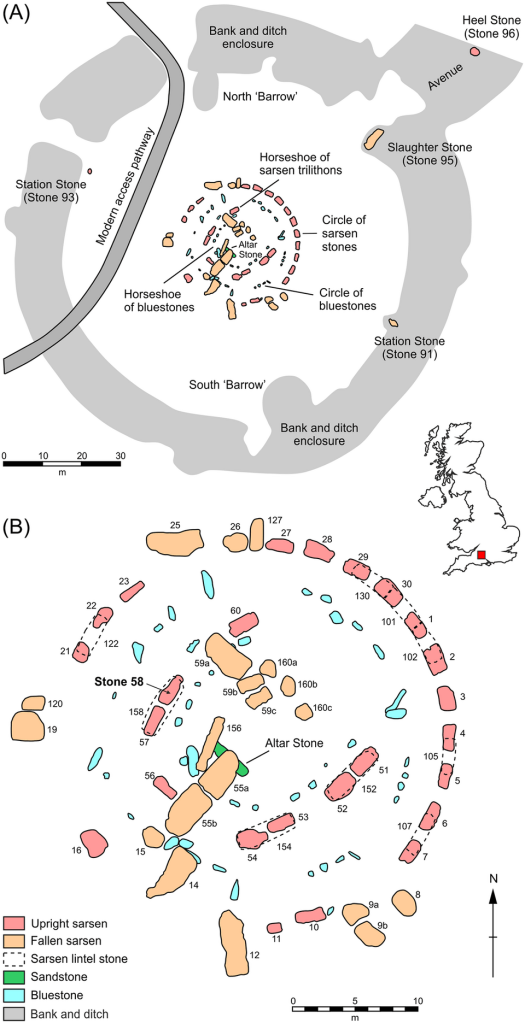
Nash et al., 2021, CC BY, via Wikimedia Commons.
Then mineral fingerprinting changed the picture.
Researchers examined tiny grains inside the stone, minerals such as zircon, rutile, and apatite, and compared them with rock samples from across Britain and Ireland. The mineral signatures did not match the Preseli Hills. They did not match Wales at all.
The Altar Stone appears to have come from northeast Scotland.
That is an astonishing distance for a Neolithic monument.
A six-tonne stone, moved at least 750 kilometres, by people with no engines, no steel, and no written map. The distance is the mystery. The planning is the achievement.
Was It Moved by Ice?
One possible answer seemed simple: maybe people did not move it at all.
During the Ice Age, glaciers carried enormous rocks across landscapes. These glacial “erratics” can travel long distances before being deposited far from their original homes. If the Altar Stone was an erratic, perhaps it was already waiting nearby, and Stonehenge’s builders simply used it.
It is a reasonable idea.
But newer research makes that explanation harder to accept as the full story.
Recent work examining possible glacial pathways suggests that ice may have moved some material part of the way, but probably not the entire distance to Salisbury Plain. Glacial transport alone does not easily explain how the stone reached a location well beyond the likely limits of the relevant ice sheets.
That means human beings likely had to move it for a major part of the journey.
Not a few metres.
Not across a field.
Hundreds of kilometres.
The Human Achievement Hidden in the Mystery
This is where the story becomes more powerful.
The Altar Stone is not just a rock. It may be evidence of connection across prehistoric Britain.
Moving a six-tonne stone over such a distance would have required planning, cooperation, route knowledge, labour, and probably a mix of transport methods. People may have used rivers, coastlines, sledges, rollers, ropes, timber tracks, or staged movement from one community to another.
We should be careful here: no one has found a written Neolithic shipping manifest. We do not know the exact route. We do not know whether the stone travelled by land, water, or a combination of both.
But that uncertainty does not make the achievement smaller.
It makes it more interesting.
The people who moved the Altar Stone were not primitive background figures in a vague prehistoric fog. They were organized. They understood landscape. They made choices that required effort far beyond basic survival.
And they moved this stone because it mattered.
Why Bring a Stone So Far?
That may be the biggest mystery of all.
Why would people go to the trouble of moving a stone from northeast Scotland to southern England?
There are practical stones everywhere. Salisbury Plain was not empty of rock. If the builders only needed a slab, they could have found one much closer.
So the Altar Stone likely meant something.
Maybe it carried ancestral significance. Maybe it represented a distant homeland, an alliance, a sacred origin, or a connection between communities separated by land and sea.
Ancient monuments often work this way.
The material is not just material. Where something comes from can matter as much as what it looks like.
A stone from far away can become a memory made physical.
Not Aliens. Not Magic. Something Better.
Whenever ancient people accomplish something difficult, modern imagination often jumps to strange explanations.
Aliens. Lost technology. Forgotten super-civilizations.
But the Altar Stone does not need any of that.
The real explanation may be more impressive.
People did it.
People with no engines. People with no steel cranes. People who lived in a world of wood, rope, stone, fire, and patience.
That does not make Stonehenge less mysterious. It makes it more human.
The Altar Stone reminds us that prehistoric people were capable of ambition on a scale we still struggle to understand.
And somewhere along the way, a six-tonne stone from the far north became part of one of the most famous monuments in the world.
The Mystery Is Not Over
The Altar Stone’s Scottish origin does not close the case.
It opens the next chapter.
Researchers still need to narrow down the exact source location in northeast Scotland. The 2024 study traced the stone to a region, the Orcadian Basin, not to a single named quarry. A 2026 follow-up, Clarke, Veness and colleagues in the Journal of Quaternary Science, titled “From Highlands to Henge”, found the closest zircon match so far in rock from Sarclet in Caithness, with a match score of 0.96, and pointed most strongly to Caithness or the Inverness and Black Isle area. That still does not name an exact quarry. They still need to reconstruct how the stone was transported, what routes were used, and whether it travelled by land, sea, or both. That 2026 study also raised the possibility that ice moved the stone part of the way, as far as Dogger Bank, now under the North Sea, before people took over, which would cut the human transport distance from about 700 kilometres to about 400 kilometres, so the route may have been mixed, not one method alone.
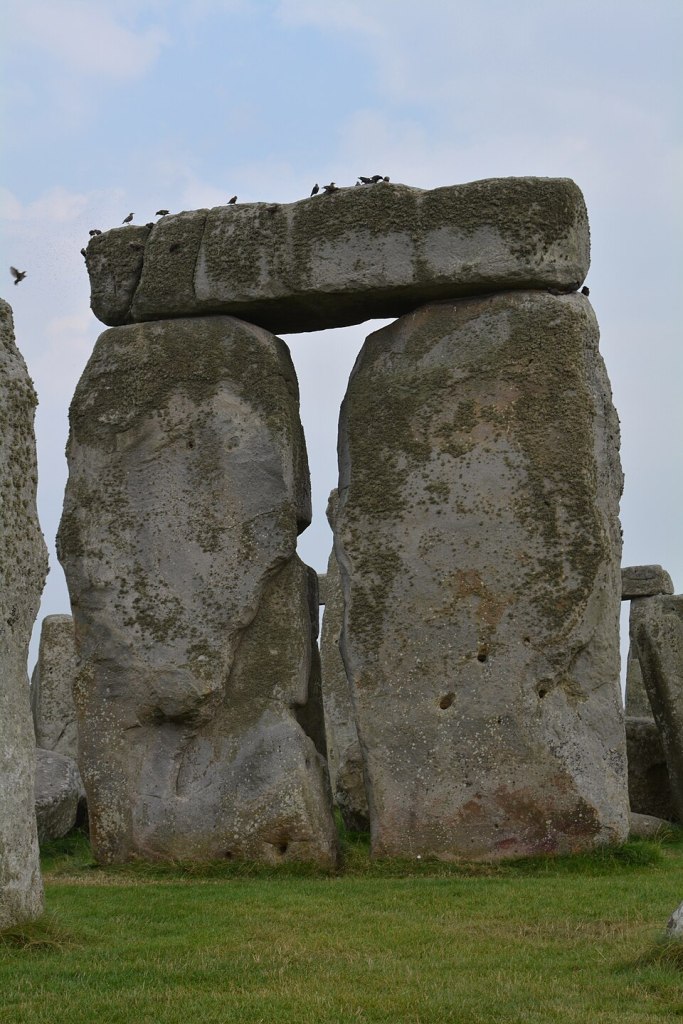
Photo by TobyEditor, CC BY 4.0, via Wikimedia Commons.
But one thing now seems increasingly clear.
Stonehenge was not an isolated monument built by a small local group with local materials.
It was part of a much wider world.
A world where people, ideas, and sacred objects could move across enormous distances.
And at the centre of that world lies a buried stone that may have crossed Britain before history had a name for it.
Final Thought
The Altar Stone’s Scottish origin does not finish the story of Stonehenge.
It deepens it.
Somewhere in northeast Scotland, a stone was chosen. Somehow, it travelled hundreds of kilometres. Somehow, it arrived at Salisbury Plain.
Eventually, it became part of one of the most famous monuments on Earth.
We may never know the full route. We may never know every hand that touched it. We may never know the words spoken when it finally reached Salisbury Plain.
But the stone is still there.
Quiet. Partly buried. Easy to miss.
And still asking the same question it has asked for thousands of years:
How far will people go for something they believe matters?
Key takeaways
- The Altar Stone is Stone 80 at Stonehenge, a 4.9 metre slab of Old Red Sandstone weighing about six tonnes, dating to around 2600 BCE.
- For a century it was assumed to come from Wales. A study published in Nature in August 2024, by Clarke and colleagues, traced its mineral fingerprint to the Orcadian Basin in northeast Scotland, at least 750 kilometres away.
- The exact quarry is still not known. The 2024 study named a region, not a single source. A 2026 follow-up found the closest match so far at Sarclet in Caithness, but that is a closest match, not a proven quarry.
- Glaciers alone do not easily explain the whole journey. People likely moved it for a major part of the way, possibly by a mix of land and sea, possibly after ice had moved it partway as far as Dogger Bank.
- Why it was brought so far is still open. Ancestral significance, alliance, sacred origin, and connection between distant communities are all possible, and none is proven.
What do you think? Was Stonehenge’s Altar Stone moved for religious reasons, political reasons, ancestral reasons, or something we have not imagined yet?
Share your thoughts in the comments, and follow The Time Traveller’s Diary for more strange discoveries, historical anomalies, and forgotten clues from the past.
Discover more from The Time Traveller's Diary
Subscribe to get the latest posts sent to your email.
