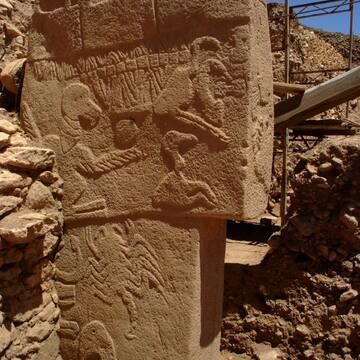
© DAI, Göbekli Tepe Project
Author: Göbekli Tepe Project
Over 12,000 years ago, long before Stonehenge or Egypt’s great pyramids, humans constructed something remarkable in what is now modern-day Turkey. Known today as Göbekli Tepe, this incredible archaeological site is changing everything historians thought they knew about our ancient past.
But who built it—and why? And why did they intentionally bury it thousands of years later?
Let’s explore the mystery behind Göbekli Tepe, the site that rewrote the history of civilization itself.
Discovery: History’s Greatest Surprise
Discovered in the 1960s, Göbekli Tepe wasn’t seriously excavated until the mid-1990s. Archaeologist Klaus Schmidt quickly realized he had uncovered something extraordinary:
- ✅ Massive stone pillars, weighing up to 20 tons each, intricately carved with animals, symbols, and unknown imagery.
- ✅ Structures built around 10,000 BCE, making them over 7,000 years older than Stonehenge.
- ✅ Evidence suggests it was deliberately buried—as if the builders wanted to hide it.
This discovery stunned historians. It suggested that hunter-gatherers could organize massive building projects thousands of years before agriculture and civilization as we know it even existed.
What Was Göbekli Tepe? The Top Theories
Göbekli Tepe’s existence has sparked intense debate. Here are the leading theories about its mysterious purpose:
1. World’s First Temple
Most archaeologists believe Göbekli Tepe was a ceremonial site or temple. The elaborate carvings and the scale of the structures indicate significant spiritual or ritualistic importance—possibly humanity’s earliest attempt at organized religion.
2. A Center for Astronomy
Some researchers theorize the site’s pillars align with specific celestial bodies, suggesting it was used as an astronomical observatory. Could early humans have tracked stars, planets, or even predicted seasonal changes?
3. Meeting Place of Ancient Tribes
Another theory argues Göbekli Tepe might have been a communal gathering place, possibly the birthplace of complex human society, where different tribes exchanged knowledge, conducted rituals, and established civilization’s earliest laws.
4. Built by a Lost Advanced Civilization
The site’s complexity and precision construction have inspired more speculative theories—was this built by a lost civilization whose history is entirely unknown, wiped out by catastrophe?
Of course, someone out there inevitably suggests aliens built it—because as we’ve learned, every ancient mystery ends with “maybe aliens.”
Why Was Göbekli Tepe Buried and Forgotten?
Perhaps the strangest mystery of Göbekli Tepe is that its builders intentionally buried it around 8,000 BCE, sealing it beneath tons of rubble and earth. Why hide something they’d worked so hard to create?
Some believe this intentional burial was meant to:
- Preserve the sacred site from enemies or natural disasters.
- Protect the temple as a sacred time capsule for future generations.
- Represent a ritual closure, marking the end of an era or tradition.
Or perhaps, something happened that forced its abandonment—something that early humans wanted to remain hidden.
Modern Research and Technology’s Role
In recent years, modern technology such as ground-penetrating radar, AI-powered imaging analysis, and 3D mapping have revealed more about Göbekli Tepe:
- ✅ New buried structures discovered beneath surrounding hills.
- ✅ Patterns indicating astronomical alignments are being analyzed to understand the site’s significance.
- ✅ Archaeologists hope advanced technology might finally answer why this incredible monument was built—and abandoned.
Your Turn—What Do YOU Think?
Göbekli Tepe continues to challenge what we think we know about ancient humanity.
- 📌 Was it the birthplace of civilization itself?
- 📌 Did its builders have advanced knowledge we have yet to uncover?
- 📌 Or could there be a simpler explanation—like ritual practice or even something mundane?
Or—let’s face it—was it aliens? (Someone always thinks it’s aliens.)
Let’s unravel this mystery together. Drop your thoughts in the comments below!
Until next time, keep exploring, keep questioning, and remember—history’s greatest mysteries often hold the keys to our future.
- 10 Ancient Cities That You Can Still Visit Today
- 10 Lost Civilizations That Mysteriously Vanished – And What Happened to Them
- History’s Greatest Lost Treasures: Myths, Mysteries, and Modern Searches
- Time Traveler’s Guide: A Day in Ancient Rome – Could You Survive?
Discover more from The Time Traveller's Diary
Subscribe to get the latest posts sent to your email.
