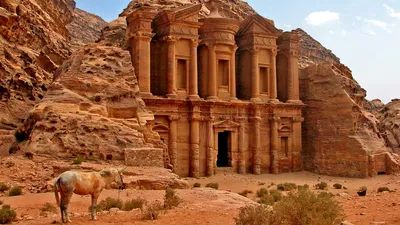
Hidden in the red sandstone cliffs of southern Jordan lies Petra, an ancient city so stunning and mysterious it was once believed to be the work of giants or gods. With temples carved directly into the rock and a history that spans centuries of trade, religion, and empire, Petra is one of the ancient world’s greatest architectural and cultural feats.
But who really built Petra? Why was it abandoned? And how did this breathtaking city vanish from history for nearly a thousand years?
The Nabataeans: Masters of Stone and Survival
Petra wasn’t built by Romans or Greeks—it was the creation of the Nabataeans, a nomadic Arab people who settled in the region more than 2,000 years ago. They became extraordinarily wealthy by controlling trade routes and charging tolls for goods like incense, spices, and silk.
Using their wealth and ingenuity, they transformed a desert canyon into a thriving metropolis with:
- ✅ Monumental tombs and temples, carved directly into rose-colored rock.
- ✅ A complex water system, including hidden cisterns, dams, and underground channels that made desert life possible.
- ✅ A multicultural influence, blending Hellenistic, Roman, and Mesopotamian architectural styles.
The Secrets of the Treasury (Al-Khazneh)
Petra’s most iconic structure is the Treasury, a massive temple facade standing nearly 40 meters high, carved with breathtaking precision. For centuries, locals believed it held pharaohs’ gold or mystical relics—though modern scholars think it was likely a tomb or temple.
Still, the fact remains: how the Nabataeans carved such monumental structures into solid rock without modern tools is still a source of awe.
Disappearance and Rediscovery
As trade routes shifted and the Roman Empire expanded, Petra’s influence declined. Eventually, the city was abandoned and lost to the outside world for nearly a millennium—until it was rediscovered in 1812 by Swiss explorer Johann Ludwig Burckhardt, disguised as a Muslim traveler.
Since then, Petra has captured the world’s imagination—as a UNESCO World Heritage Site, a modern wonder, and a symbol of ancient ingenuity.
Modern Discoveries and Unsolved Mysteries
Even today, much of Petra remains unexcavated. Recent satellite scans and drone imaging suggest the city may be twice as large as previously thought.
Unsolved questions still linger:
- What rituals took place in the temples and hidden chambers?
- Were some structures used for astronomy?
- How did the Nabataeans disappear so quietly from history?
Your Turn—What Do YOU Think?
Was Petra purely a trading capital, or something more spiritual? Could there still be hidden chambers or secrets beneath the sandstone?
Share your theories in the comments!
Until next time, keep exploring, keep questioning—and remember: sometimes, the most breathtaking wonders are hidden in plain sight.
- The Mycenaean legacy: how Greece remembered itself
- Stoicism in Uncertain Times: Ancient Wisdom for Modern Anxiety
- The Map That Shouldn’t Exist: The Mystery of the Piri Reis Chart
- The Sky Stone of Sierra Leone: A Geological Mystery or a Forgotten Artifact?
Discover more from The Time Traveller's Diary
Subscribe to get the latest posts sent to your email.
