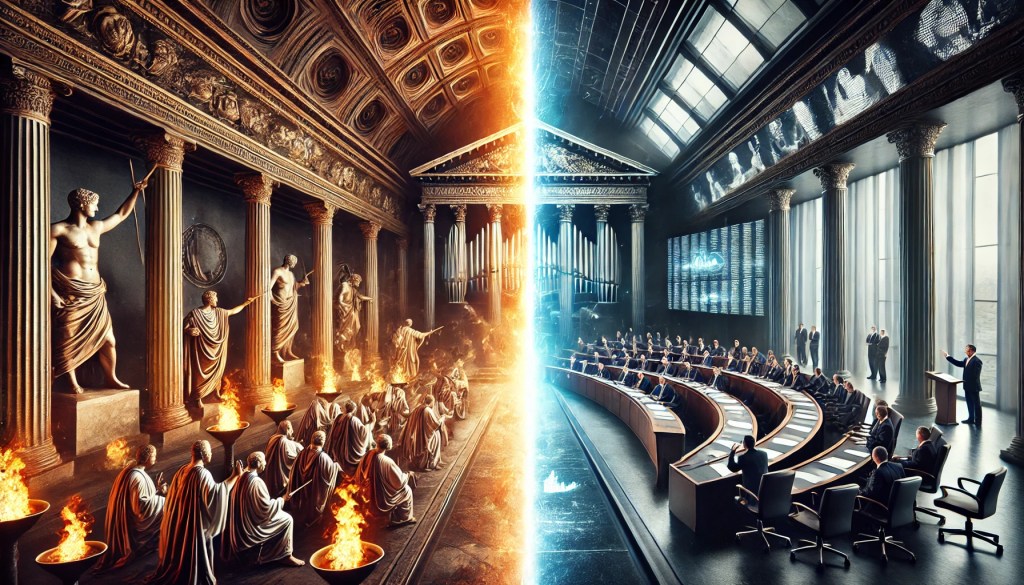
When we think of ancient politics, we often picture togas, empires, and emperors—far removed from today’s suited politicians and 24/7 news cycles. But look closer, and you’ll find that the power struggles, propaganda, populism, and public unrest of ancient civilizations aren’t that different from what we see in modern times.
So what can we actually learn from the political worlds of ancient Rome, Athens, Egypt, or Mesopotamia? Quite a bit, it turns out.
Let’s take a journey through history’s old corridors of power—and see how the echoes still resonate today.
1. The Danger of Personality Over Policy – Rome’s Rise (and Fall)
Ancient Rome thrived as a republic for centuries—until its system slowly gave way to dictatorship and empire. Figures like Julius Caesar, beloved by the masses but distrusted by the Senate, blurred the lines between public servant and absolute ruler.
Lesson:
When political figures become larger than the system itself, democracy weakens.
→ Sound familiar?
2. Democracy Requires Engagement – Athens and the Power of the People
Classical Athens gave us democracy in its earliest form—but it came with expectations. Citizens were expected to debate, vote, and participate directly. When apathy or manipulation took hold (think: demagogues like Alcibiades), the system faltered.
Lesson:
Democracy doesn’t run on autopilot. Public participation isn’t just a right—it’s a responsibility.
→ Modern voter turnout and public trust say a lot here.
3. Propaganda Isn’t New – Pharaohs & Image Control
Egyptian pharaohs were masters of controlling narrative. From temple walls to massive statues, they shaped public perception through image, myth, and monument. Even defeats were spun as “divine tests.”
Lesson:
Controlling the message is power. The tools may change—stone carvings then, social media now—but the intent stays the same.
→ Who tells the story still matters.
4. Corruption Is Eternal – Babylon to Bureaucracy
Ancient Mesopotamian tablets include complaints about bribery, unequal treatment, and favoritism in legal and political systems. Sound familiar? Corruption, it seems, is as old as civilization itself.
Lesson:
Accountability and transparency have always been the antidote—but require constant effort.
→ Checks and balances aren’t just modern ideas—they’ve always been the need of a balanced civilization.
5. Fear as a Political Tool – From Sparta to Empires
Fear was often used to control populations—from harsh laws in Sparta to Rome’s public executions. Stability was prioritized over personal freedoms, especially during times of crisis.
Lesson:
Fear can unify—or divide. It can maintain order or justify overreach.
→ The context always matters—but so does watching for the line.
6. Collapse Often Comes from Within
Most ancient empires didn’t fall solely because of outside invasion—they collapsed due to internal division, mismanagement, inequality, or loss of public trust.
Lesson:
Nations are rarely destroyed by enemies alone. Erosion from within is usually the real threat.
→ Empires rise on strong foundations—then crack under neglected ones.
Final Thought: History Repeats—But Only If We Let It
Ancient politics weren’t primitive—they were just different tools in the same game of power. And while our structures and technology have evolved, human nature… hasn’t really changed all that much.
We may not wear togas or carve laws into stone tablets anymore, but the questions our ancestors wrestled with—Who gets power? How do we share it? What happens when it’s abused?—are still with us today.
The difference is: we have the benefit of hindsight.
Let’s use it.
- The Mycenaean legacy: how Greece remembered itself
- Stoicism in Uncertain Times: Ancient Wisdom for Modern Anxiety
- The Map That Shouldn’t Exist: The Mystery of the Piri Reis Chart
- The Sky Stone of Sierra Leone: A Geological Mystery or a Forgotten Artifact?
- Easter’s Ancient Roots: How Old Traditions Shaped Modern Celebrations
Discover more from The Time Traveller's Diary
Subscribe to get the latest posts sent to your email.
