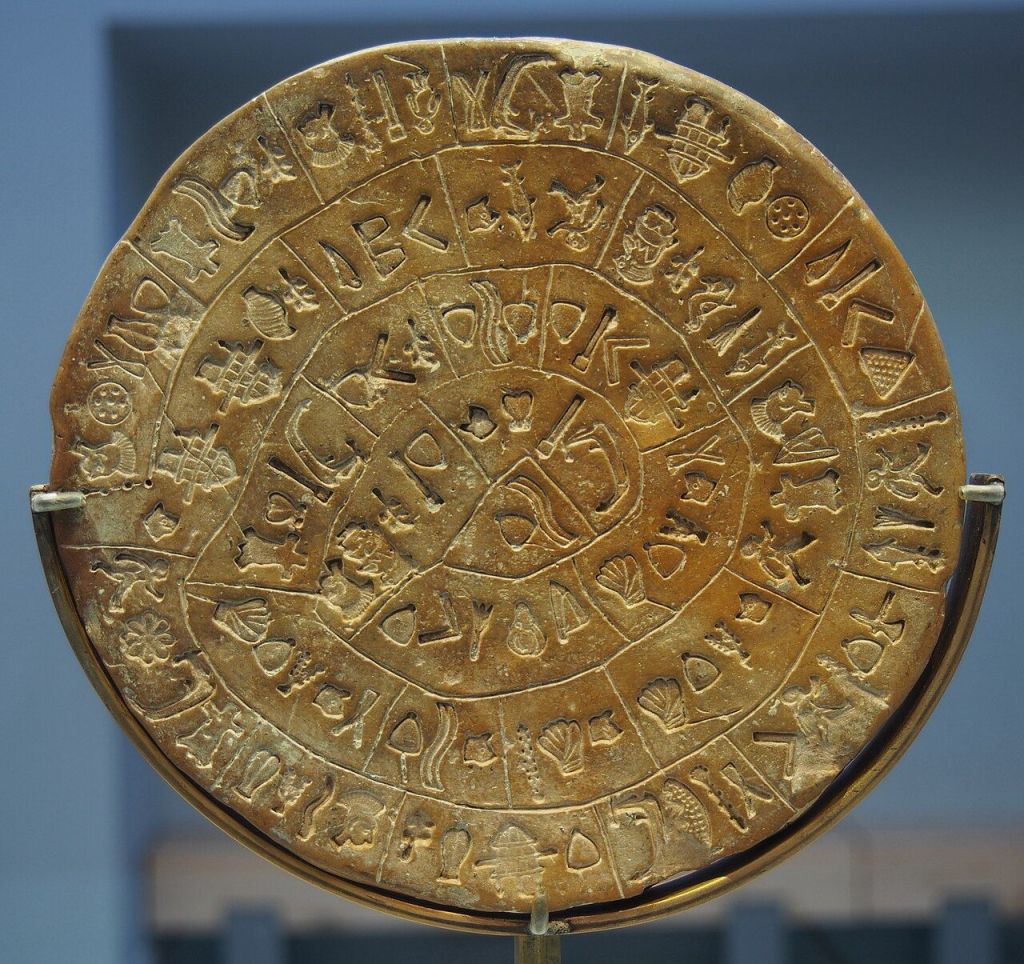
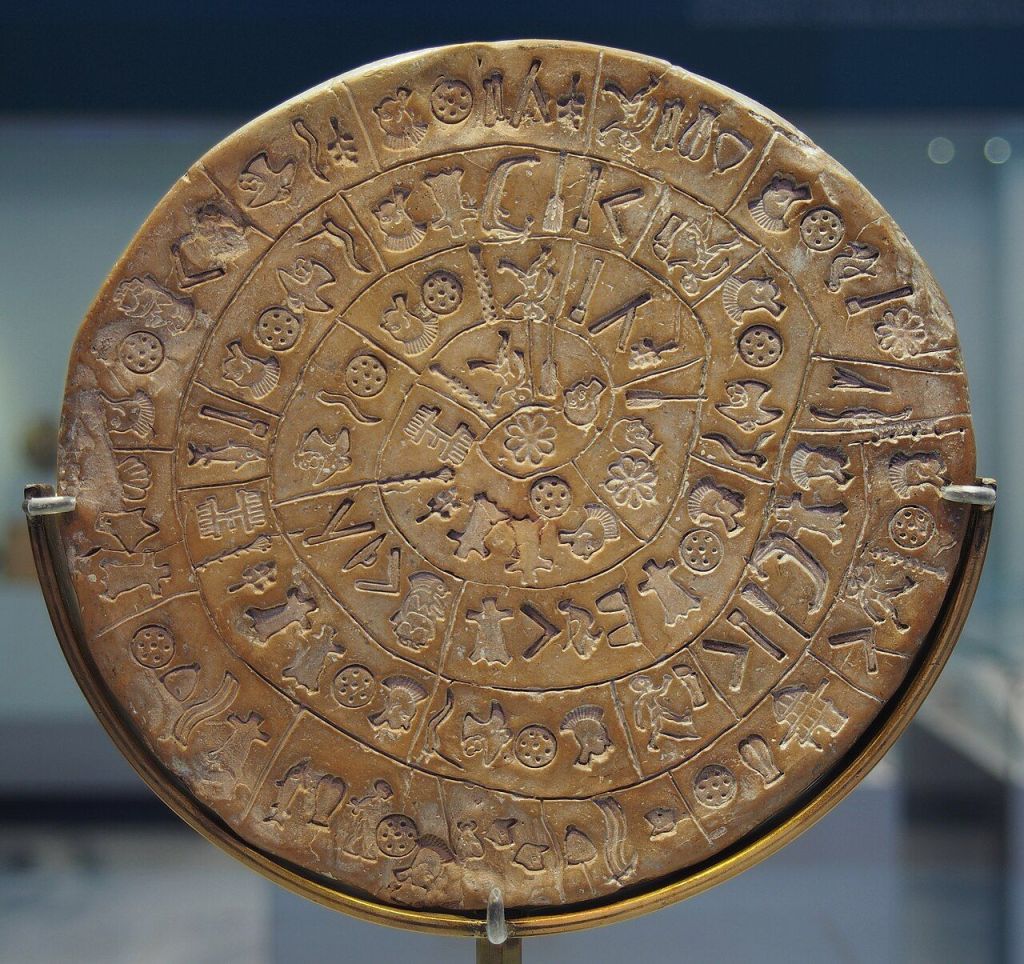
In 1908, archaeologists in Crete unearthed a small, unassuming clay disc—yet more than a century later, it remains one of history’s greatest unsolved puzzles.
Covered in 241 mysterious symbols arranged in a spiral pattern, the Phaistos Disc is unlike any other artifact from the ancient world. Scholars have debated its meaning for over a century, yet no one has fully deciphered it.
Some believe it’s a religious text, others say it’s a lost language, and a few even question whether it’s a hoax.
But now, modern technology—including artificial intelligence (AI)—is stepping in to decode the past in ways we never could before.
Could we finally be on the verge of unlocking its secrets? Let’s dive into the history, the theories, and how AI is offering a new way forward.
The Discovery: A Puzzle from the Minoan World
The Phaistos Disc was discovered in the ruins of the Minoan palace of Phaistos in southern Crete, dating to around 1700 BCE. It is made of fired clay, about 15 cm (6 inches) in diameter, and inscribed with 45 unique symbols that repeat in a spiral formation on both sides.
But here’s what makes it so extraordinary:
- ✅ The symbols were stamped—not carved—suggesting an early form of movable type printing, 3,000 years before Gutenberg.
- ✅ The symbols don’t match any known ancient writing system, including Minoan Linear A and Linear B.
- ✅ It’s the only artifact of its kind ever found—nothing else remotely similar exists.
This uniqueness makes it both valuable and frustrating. Unlike the Rosetta Stone, which provided a translation key for Egyptian hieroglyphs, the Phaistos Disc stands alone—no translations, no references, no known related scripts.
What Could the Phaistos Disc Be? Leading Theories
For over a century, historians and linguists have tried to make sense of this artifact. Here are the most widely debated theories:
1. A Religious or Ritual Text
Many scholars believe the disc could be a sacred hymn, prayer, or ceremonial guide from the Minoan civilization. The repeated symbols might represent chants or instructions for religious rites.
2. A Calendar or Astronomical Record
Some theorists suggest the disc could be a lunar or solar calendar, mapping celestial movements for agricultural or spiritual purposes.
3. A Lost Language or Writing System
The most intriguing theory is that it represents a lost script, possibly a forgotten branch of Minoan or Anatolian writing. If true, it could completely rewrite what we know about early European civilizations.
4. A Hoax or Experiment?
Some skeptics argue that since no other artifacts like it have been found, it might have been a Minoan experiment in printing, or even a forgery made long after the civilization fell.
How AI Is Helping to Decode the Phaistos Disc
For decades, human researchers have tried (and failed) to crack this ancient code. Now, AI is offering new insights.
Here’s how modern technology is being used to analyze the disc:
1. AI-Based Pattern Recognition
AI models scan the symbols for repeating patterns, attempting to group them into words, syllables, or phrases—something humans might miss.
Some studies suggest that certain symbols might function like prefixes or suffixes, hinting at a structured written language.
2. Comparing Symbols to Other Ancient Scripts
AI can compare the Phaistos Disc’s symbols to thousands of other writing systems in mere seconds.
Some researchers are testing its similarity to Linear A, Hittite hieroglyphs, and Anatolian scripts.
3. Predicting Phonetic Sounds
Machine learning tools are trying to match symbols with phonetic sounds by analyzing their structure.
Some models have proposed tentative phonetic values, though no full translation exists yet.
4. Digital Simulations & Historical Context
AI can analyze Minoan trade, religion, and artifacts to predict what kinds of messages the disc might contain.
By considering the broader historical context, AI may help narrow down the meaning of the symbols.
What Has AI Found So Far?
AI has not fully deciphered the disc yet, but it has identified structural patterns that indicate it’s more than just decorative symbols.
Some models suggest it could be a form of early syllabic writing, similar to how Japanese kanji works today.
Other findings hint at connections to religious or administrative Minoan texts.
While we don’t have a definitive answer yet, AI is providing clues that researchers never had before.
Why the Phaistos Disc Still Fascinates Us
The Phaistos Disc remains one of the greatest unsolved mysteries of the ancient world. Its strange symbols, unknown origins, and complete lack of context make it one of archaeology’s most frustrating yet thrilling puzzles.
Will it one day be deciphered? And if so, will it reveal a groundbreaking discovery—or something far more mundane?
Only time (and AI) will tell.
Closing Thoughts
So, what do you think?
- 📌 Is the Phaistos Disc a lost language, waiting to be unlocked?
- 📌 Was it a religious text, a calendar, or something completely unexpected?
- 📌 Could AI finally crack the code, or will this mystery remain unsolved?
Drop your thoughts in the comments below! Until next time, keep questioning, keep exploring, and remember—history’s greatest mysteries may one day hold the answers to our past.
The Phaistos Disc
https://messaramuseum.gr/site/dynamic-mouseio.shtml?type=page&id=348&lang=en
Discover more from The Time Traveller's Diary
Subscribe to get the latest posts sent to your email.
