In 1901, sponge divers exploring a shipwreck off the coast of Antikythera, Greece, made a discovery that rewrote history—a mysterious, heavily corroded bronze artifact with intricate gears and inscriptions.
At first, no one understood its purpose. But as scientists studied it, they realized it was a mechanical device so advanced that it seemed impossible for its time. Now known as the Antikythera Mechanism, this 2,000-year-old artifact is believed to be the world’s first analog computer.
But how did the ancient Greeks develop such sophisticated technology? Could this device be evidence of lost knowledge or an even greater mystery?
Let’s dive into the incredible story of the Antikythera Mechanism—one of history’s most astonishing unsolved puzzles.
The Discovery of the Antikythera Mechanism
In April 1900, Greek sponge divers searching for natural sponges off the island of Antikythera stumbled upon an ancient shipwreck dating back to 60–70 BC. Among the bronze statues, jewelry, and pottery, they found a mysterious lump of corroded metal that seemed out of place.

📜 Key Facts About the Discovery:
The shipwreck was believed to be a Roman cargo ship, carrying looted treasures from Greece.
The artifact was found in pieces, encrusted with marine deposits after centuries underwater.
Initial theories dismissed it as a broken astrolabe or a navigational tool.
It wasn’t until decades later that scientists realized the true significance of the Antikythera Mechanism.
What Does the Antikythera Mechanism Do?
After decades of study, researchers uncovered the astonishing capabilities of the Antikythera Mechanism.
🔎 It Was an Astronomical Calculator:
Predicted solar and lunar eclipses with extreme accuracy.
Tracked the movements of the Sun, Moon, and planets based on ancient Greek astronomy.
Displayed the phases of the Moon and could adjust for its irregular orbit.
Possibly used to set dates for the Olympic Games and other events.
🔎 A Gear System Centuries Ahead of Its Time:
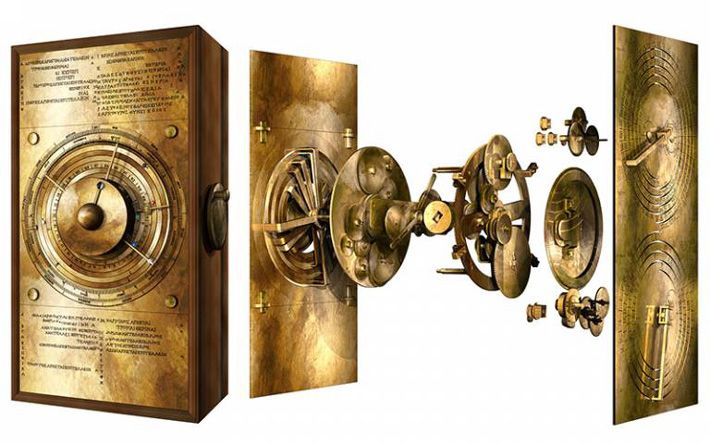
The mechanism contained over 30 interlocking bronze gears—a level of engineering that wouldn’t be seen again until 1,400 years later in medieval Europe.
Each gear was precisely cut, allowing the device to perform complex calculations.
The level of craftsmanship suggests it was made by an unknown ancient genius.
How did the Greeks create something so mechanically advanced, and why wasn’t this technology seen again for over a millennium?
Theories About Its Origins – Who Built It?
📜 Theory #1: A Masterpiece of Ancient Greek Engineering
Most historians believe the Antikythera Mechanism was built by Greek scientists and mathematicians.
Some link it to the teachings of Archimedes, one of history’s greatest inventors.
However, no other devices of this complexity have been found from the same era.
📜 Theory #2: A Lost Invention from an Unknown Civilization
Some researchers speculate that the Antikythera Mechanism wasn’t just a one-time invention—it could have been part of a lost tradition of advanced technology.
Could there have been an entire school of mechanical engineering in the ancient world that was later forgotten?
📜 Theory #3: Evidence of Ancient Extraterrestrial Influence?
Some fringe theorists claim that the device is too advanced for its time, suggesting outside influence.
While there is no concrete evidence of alien involvement, the mechanism does challenge our understanding of ancient civilizations.
Could There Be More Antikythera-Like Devices?
The Antikythera Mechanism raises an exciting question: Was this the only one of its kind, or are there more waiting to be discovered?
🔎 Challenges to Finding More:
The bronze gears would have corroded over time, making them nearly impossible to recover.
Ancient texts mention mechanical devices used by Greek scientists, but none have survived.
🔎 Ongoing Research & New Discoveries:
Modern 3D scans have revealed more details of the mechanism’s inscriptions, helping to decode its functions.
Some researchers believe that other advanced Greek devices may have existed but were lost to history.
The Antikythera Mechanism proves that ancient civilizations were far more technologically advanced than we once believed.
Conclusion – A Mystery That Challenges History
The Antikythera Mechanism is more than just an ancient artifact—it’s a window into a lost era of innovation and genius.
Was it the work of a single brilliant mind, or part of a forgotten tradition of advanced engineering?
Could other ancient civilizations have had similar or even more advanced knowledge?
And what other mysteries from history remain hidden beneath the ocean, waiting to be found?
The answers may still be out there. Until then, the Antikythera Mechanism remains one of history’s greatest unsolved mysteries.
What do you think? Was this a one-time wonder, or evidence of a lost world of ancient technology? Let us know in the comments!
Discover more from The Time Traveller's Diary
Subscribe to get the latest posts sent to your email.
